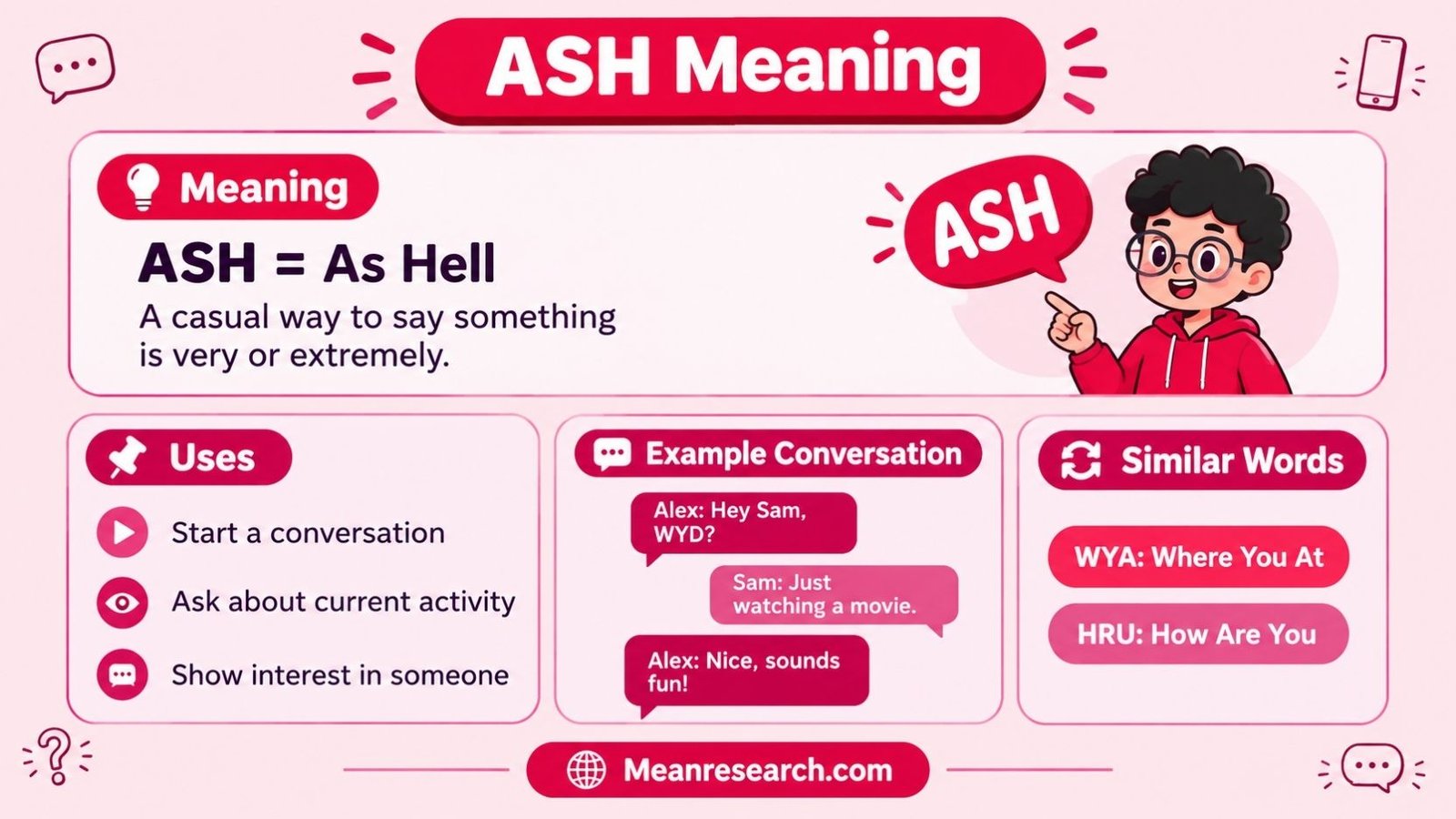
If you have seen the word “ash” pop up somewhere it doesn’t seem to belong, like at the end of a sentence right after an adjective, you are not imagining things. In slang, “ash” is a shortened, spoken-style version of “as hell.” People use it to make a description stronger, the same way “very” or “extremely” would. “I’m tired ash” simply means “I’m tired as hell,” and “that’s funny ash” means the thing being described is very funny.
This guide breaks down where the word comes from, how it is actually used across platforms like TikTok, Instagram, and text messages, and how it differs from the literal meaning of ash as burnt residue. You will also see how phrases like “bad ash,” “fine ash,” “tuff ash,” and “dry ash” each carry their own specific tone, along with guidance on when the slang fits and when it does not.
What Does ASH Mean In Slang?
In text and social slang, ash is an intensifier that stands in for the phrase “as hell.” It attaches to an adjective to push the meaning further, turning an ordinary statement into an exaggerated one. Instead of writing “I’m hungry as hell,” a person types “I’m hungry ash,” because it is faster and reads as more casual.
This use has nothing to do with fire or burning. The spelling simply reflects how “as hell” sounds when it gets clipped down in fast, informal typing. Context is what separates the slang meaning from the literal one, since the same three letters can point to two completely different ideas depending on where they appear in a sentence.
Quick Definition
| Term | Meaning | Example |
| Ash (slang) | An intensifier meaning “as hell” or “very” | “This pizza is good ash.” |
| Ash (literal) | The gray or black powder left after something burns | “Sweep the ash out of the fireplace.” |
| Ashy (slang) | Describes dry, flaky skin, unrelated to the intensifier | “Put lotion on, your elbows look ashy.” |
Where Did ASH Slang Come From?
The most widely repeated explanation is that “ash” grew out of the spoken phrase “as hell,” which people have used casually for decades to add emphasis to a statement. As texting and social captions became a bigger part of daily communication, users began shortening common phrases to save time and keystrokes, and “as hell” gradually contracted into “ash.”
There is no single confirmed inventor or viral post that started the trend, which is typical of internet slang that spreads through everyday use rather than one clear origin point. Language commentators who track online slang connect the rhythm and style of the term to African American Vernacular English and broader youth internet culture, both of which have shaped a large share of the slang that spreads through platforms like TikTok. The term picked up steam roughly between 2020 and 2022, moving from casual speech into captions, comments, and direct messages until it became a recognizable part of Gen Z vocabulary.
Note: Because slang spreads informally, exact origin dates and first uses are difficult to verify with certainty. Treat timeline estimates as general trends rather than fixed facts.
ASH Meaning on TikTok
On TikTok, ash shows up constantly in captions and comments as a quick way to react without typing a full sentence. A comment like “this is funny ash” or “so relatable ash” lands the same punch as “this is so funny” but fits the platform’s fast, casual comment culture better.
TikTok’s audience skews younger, and short, snappy reactions perform well in a feed built around quick engagement. Because the app rewards brevity, ash functions almost like punctuation, letting someone react to a video, a sound, or a trend in just a couple of words. You will also see it paired with fire or laughing emojis, which adds visual emphasis to the verbal one.
Example Usage on TikTok
- “This trend is funny ash 😭”
- “Bro said something wild ash”
- “That transition was clean ash”
ASH Meaning In Text Messages
In one-on-one texting, ash tends to carry genuine emphasis rather than performance for an audience. A message like “I’m hungry ash, let’s eat” is a straightforward way of saying “I’m really hungry,” sent between friends who already understand the shorthand.
Texting strips away tone of voice, so intensifiers like ash help convey how strongly someone feels about what they are saying. It reads as more casual and more emotionally expressive than typing out “as hell” in full, which is part of why it has stuck around in everyday messaging between friends, especially younger users.
Quick Tip: If a text ends in “ash” right after a describing word, read it as “as hell” and the sentence usually makes sense right away. “I’m confused ash” becomes “I’m confused as hell.”
ASH Meaning On Instagram
On Instagram, ash shows up most often in comment sections under photos, where it works as a fast compliment or reaction. Phrases like “pretty ash” or “fine ash” appear under selfies constantly, functioning as a quick way to hype someone up without writing a longer comment.
Because Instagram comments are public and often left by people who follow an account but do not personally know the poster, the slang works as a low effort way to show appreciation or agreement. It is common enough that many users expect to see it under photo posts, especially from younger audiences.
Common ASH Phrases And What They Mean
Different adjectives paired with “ash” create phrases with their own specific flavor. Below is a breakdown of the most searched and most commonly used combinations, along with what each one is actually communicating.
Bad Ash Meaning Slang
“Bad ash” usually means something is very bad, expressing strong disagreement or frustration. Someone might type “this take is bad ash” to disagree strongly with an opinion, or “my day was bad ash” to describe a genuinely rough day.
The tone depends heavily on who is saying it and the relationship between the people talking. Among friends, “bad ash” often carries a joking, exaggerated feel rather than something meant to be taken as harshly as it reads.
Fine Ash Meaning Slang
“Fine ash” is a compliment describing someone as very attractive, most often used to describe how someone looks. It shows up constantly in comment sections under photos, working as a quick way to say a person looks good without writing a longer message.
The phrase is a direct stand-in for “fine as hell,” where “fine” already means attractive in casual slang, and “ash” pushes the compliment further. It leans playful and complimentary, and it is one of the most common ash phrases you will see in Instagram comments and TikTok captions.
Fine Ash Meaning in Text
When someone texts “you look fine ash” or simply “fine ash” under a photo, they are saying the person looks extremely attractive. It functions the same way whether typed as a comment, a caption reply, or a direct message, and it almost always carries a positive, flattering tone.
Tuff Ash Meaning Slang
“Tuff” is a stylized spelling of “tough,” and in slang it usually means impressive, cool, or excellent rather than physically hard or difficult. “Tuff ash” combines that meaning with the intensifier, so it describes something as extremely impressive or extremely cool.
You will see it used for anything from an outfit to a performance to a clever comeback. “That fit is tuff ash” means the outfit looks genuinely great, not that it is literally tough in a physical sense.
Pretty Ash Meaning Slang
“Pretty ash” works almost identically to “fine ash,” meaning very pretty or extremely attractive. It shows up as a compliment under photos and in captions, and the word “pretty” being boosted by “ash” simply intensifies the existing compliment.
If someone calls you “pretty ash,” it is meant as praise, not criticism. The phrase carries a warm, appreciative tone rather than anything negative.
Dry Ash Meaning Slang
“Dry” in slang already means boring, unenthusiastic, or lacking energy, separate from its literal meaning related to moisture. “Dry ash” intensifies that, describing something or someone as extremely boring or extremely unenthusiastic.
A conversation, a party, or even a person’s personality can be described as “dry ash” when they come across as flat or unengaging. It is generally used casually and is not usually meant as a serious insult, though tone and context still matter.
Cool Ash, Cold Ash And Hard Ash
These follow the same pattern as the phrases above, with “ash” simply intensifying whatever adjective comes before it. “Cool ash” means very cool or impressive, “cold ash” can describe literal temperature (“it’s cold ash outside”) or a harsh, blunt statement, and “hard ash” typically means something is very difficult or very impressive, depending on context.
Comparison Table: Common ASH Phrases
| Phrase | Meaning | Tone |
| Bad ash | Very bad, or strong disagreement | Negative, sometimes joking |
| Fine ash | Very attractive | Positive, complimentary |
| Tuff ash | Very impressive or cool | Positive |
| Pretty ash | Very pretty | Positive, complimentary |
| Dry ash | Very boring or unenthusiastic | Neutral to negative |
| Cool ash | Very cool or impressive | Positive |
ASH Meaning In Spanish Slang
Because internet slang spreads quickly across platforms that reach bilingual and international audiences, “ash” has also crossed into casual texting among Spanish speaking Gen Z users, particularly those who split their time between English and Spanish language content online. In this context, it is generally borrowed the same way as in English, functioning as an intensifier rather than taking on a separate Spanish definition.
It is worth noting that “ash” is unrelated to the Spanish interjection “ash,” which some Spanish speakers already use to express annoyance or frustration, similar to “ugh” in English. That usage predates the English slang trend and comes from a completely different source, so the same three letters carry two unconnected meanings depending on the speaker and the language context.
ASH vs Similar Slang Terms
Ash is not the only intensifier circulating online, and comparing it to similar terms helps clarify exactly where it fits.
Comparison Table: ASH vs AF vs AS HECK
| Term | Full Meaning | Tone | Common Platforms |
| Ash | As hell | Casual, playful | TikTok, Instagram, texting |
| AF | As f*** | Stronger, more vulgar | Twitter/X, texting, captions |
| As heck | As heck (softer version of as hell) | Mild, family-friendly | Texting, casual speech |
“AF” is generally considered a stronger and more explicit intensifier than “ash,” since it stands in for a swear word rather than a milder phrase. “Ash” sits in a middle ground: casual and expressive without being considered a direct profanity, which is part of why it spread so widely across platforms with younger audiences.
Is ASH A Swear Word?
Ash is not a swear word on its own. It is informal slang, and while it stems from the phrase “as hell,” which some people consider mildly impolite, the shortened form has become mainstream enough that most people do not read it as offensive.
That said, because of where it comes from, ash is still considered informal and generally is not appropriate for professional, academic, or business communication. In casual conversation between friends or on social media, it reads as normal slang rather than something crude.
Warning: Even though ash itself is mild, avoid using it in formal emails, school assignments, resumes, or workplace messaging, since it can come across as unprofessional regardless of how common it is in casual settings.
Other Meanings of ASH Outside of Slang
The word ash existed long before the slang usage, and it still carries several important meanings depending on the context. Understanding these helps avoid confusion when the word shows up outside of texting or social media.
Ash As Burnt Residue
The original and most common meaning of ash is the powdery gray or black substance left behind after something burns completely. Wood, paper, coal, and cigarettes all leave ash once they are consumed by fire, and the material is closely tied to ideas of destruction, heat, and what remains after burning.
This meaning still appears constantly in everyday language, both literally and symbolically. Someone might literally clean ash out of a fireplace, or use it symbolically, as in the phrase “reduced to ash,” to describe something that has been destroyed.
Ashes And Symbolism
The plural form “ashes” carries strong symbolic and emotional weight, especially in religious, poetic, and funeral contexts. In Christian tradition, ashes are placed on the forehead during Ash Wednesday as a symbol of repentance and human mortality, and the phrase “ashes to ashes” is closely associated with funeral language describing the body’s return to the earth after death.
In everyday emotional language, “left in ashes” describes something that has been destroyed, such as hopes, plans, or relationships. This use of the word carries a heavier, more solemn tone than the casual slang intensifier, and the two should not be confused despite sharing the same spelling.
Ash In Science And Medicine
Outside of slang and symbolism, “ash” also functions as a standard scientific term. In physics and material science, ash refers to the inorganic residue left after burning a material, and it is used as a precise measurement in fields like fuel analysis and combustion research.
In healthcare, ASH can stand for different medical abbreviations depending on the institution or specialty, such as organizations related to hematology. Because medical abbreviations vary between documents and providers, the intended meaning should always be confirmed from the surrounding context rather than assumed.
Ash In Aviation
Within aviation, ash most commonly refers to volcanic ash, which poses serious safety risks to aircraft engines and visibility. Volcanic ash clouds are closely monitored by aviation authorities, and flight paths are often adjusted or grounded entirely when significant ash clouds are present in the atmosphere.
Ash As A Name
Ash is also a common given name, often short for Ashley, Asher, or Ashton, and it appears widely as both a first name and a nickname. In this context, it has no connection to either the slang intensifier or the literal meaning tied to burning.
Ashy: A Related but Different Slang Term
“Ashy” is sometimes confused with the ash intensifier, but the two are unrelated. Ashy describes skin, most often elbows, knees, or hands, that looks dry, pale, or flaky, usually because it needs lotion or moisturizer.
Where “ash” as an intensifier boosts an adjective, “ashy” is itself a descriptive adjective, and it always relates back to the literal appearance of skin resembling ash or dust. Mixing these up is a common point of confusion, so it helps to remember that ashy always describes something looking dry, while ash as slang always intensifies whatever word comes right before it.
How to Use ASH Correctly in a Sentence
Getting the placement right is simple once you see the pattern. Ash almost always follows the adjective it is intensifying, rather than coming before it or standing alone as its own word.
Correct Usage Examples
- “This weather is cold ash.” (very cold)
- “That movie was funny ash.” (very funny)
- “I’m tired ash after that shift.” (very tired)
- “Her outfit was clean ash.” (very stylish or sharp)
Incorrect Usage
- “Ash cold this weather is.” (wrong word order)
- “I’m ash.” (missing the adjective it should intensify)
When Not to Use ASH Slang
Even though ash is common and generally mild, there are settings where it does not belong. Understanding when to avoid it helps prevent awkward or unprofessional communication.
- Formal emails to professors, employers, or coworkers
- Resumes, cover letters, or professional bios
- Academic essays or research papers
- Customer service or business communication
- Conversations with people unfamiliar with current slang, where it may cause confusion instead of clarity
Quick Tip: If you would not say “as hell” out loud in a given setting, it is best to skip “ash” as well, since the slang carries the same casual weight as the full phrase it replaces.
Frequently Asked Questions
What does ash mean in text?
In text messages, ash most commonly means “as hell,” used right after an adjective to add emphasis, similar to saying “very” or “extremely.”
What does ash mean on TikTok?
On TikTok, ash works the same way it does in texting, intensifying captions and comments like “funny ash” or “relatable ash” to react quickly to content.
Is ash a bad word?
No, ash is not considered a bad word. It is informal slang, though it is best avoided in professional or formal communication.
What does bad ash mean?
Bad ash means something is very bad or expresses strong disagreement, though among friends it often carries a joking, exaggerated tone.
What does fine ash mean?
Fine ash is a compliment meaning someone is very attractive, commonly used under photos on Instagram and TikTok.
What does tuff ash mean?
Tuff ash means very impressive or very cool, using the slang spelling of “tough” to describe something excellent rather than physically hard.
What does dry ash mean?
Dry ash describes something or someone as very boring or lacking energy, building on the existing slang meaning of “dry.”
Does ash have a Spanish meaning too?
Ash has crossed into casual texting among some Spanish speaking Gen Z users as a borrowed English intensifier, separate from the unrelated Spanish interjection that also happens to sound similar.
How is ash different from AF?
Ash means “as hell” and reads as casual and mild, while AF stands for a stronger, more vulgar phrase and generally carries a more explicit tone.
Where did ash slang come from?
Ash likely developed from the spoken phrase “as hell” being shortened during fast, casual texting, spreading widely on social platforms between roughly 2020 and 2022.
Final Takeaway
Ash meaning slang comes down to one simple idea: it is a fast, casual way of saying “as hell” to intensify whatever word comes before it. Whether you see it as “fine ash,” “bad ash,” “tuff ash,” or “dry ash,” the underlying pattern stays the same, and once you recognize it, decoding the sentence becomes second nature.
Outside of slang, ash still holds its original meanings tied to burning, mourning, science, and aviation, so context always determines which definition applies. Keep the slang for casual texting and social media, and you will use it exactly the way it is meant to be used.

Hooriya Salman is the writer and researcher behind Mean Research, with 4 years of experience researching and writing about word meanings, slang, names, and everyday language. Their aim is to provide clear, accurate, and easy-to-understand explanations that help readers discover the meaning behind unfamiliar words, expressions and names.