
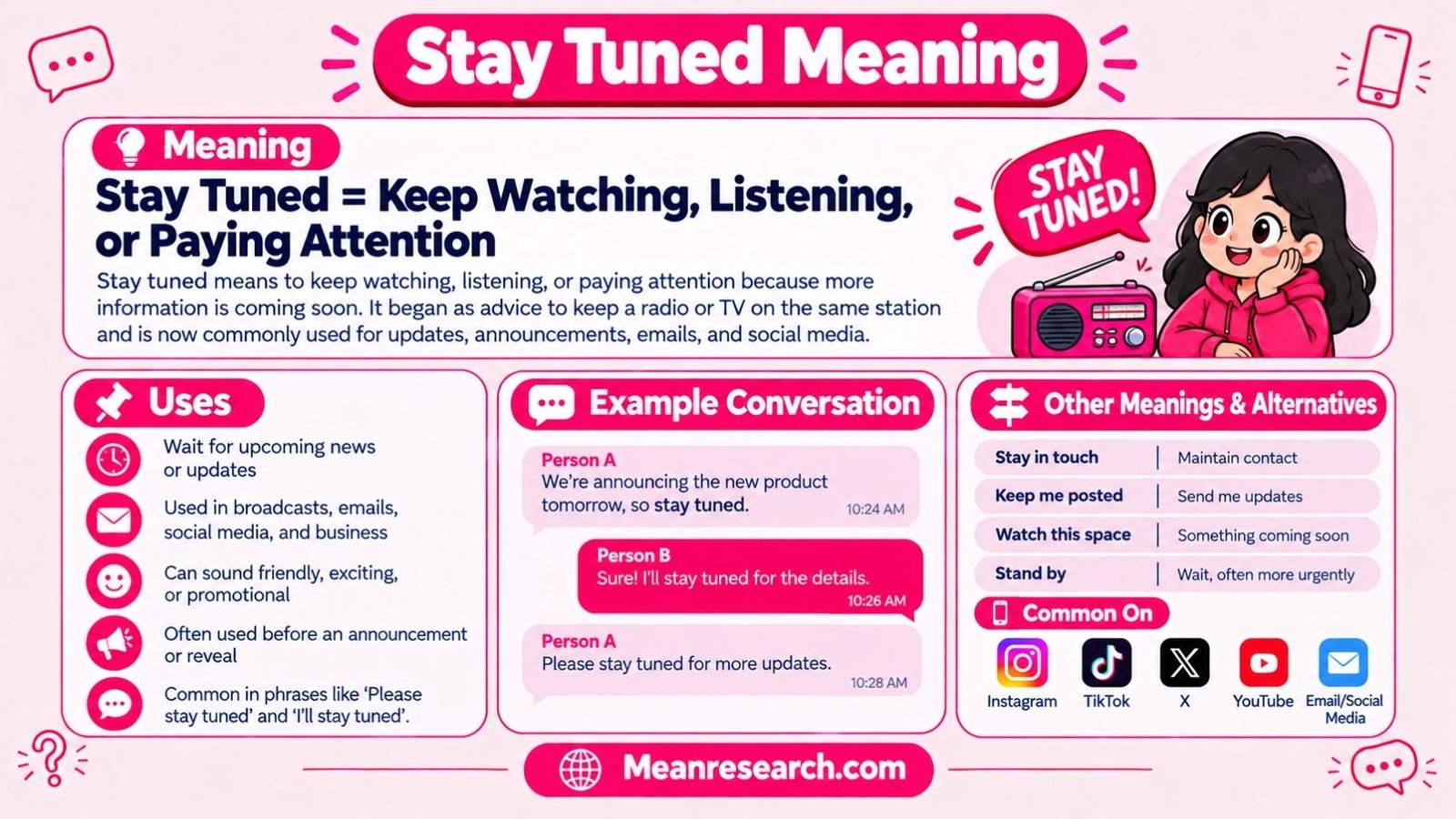
“Stay tuned” means to keep watching, listening, or paying attention because more information is coming soon. It started as literal advice to leave a radio or television dial set to the same station, and it has since grown into a figurative phrase used in emails, social media, business updates, and everyday conversation whenever someone wants you to wait for news that hasn’t arrived yet.
That one sentence answers the core question, but the phrase carries more nuance than most quick definitions capture. Below is a complete, dictionary backed breakdown of where it came from, what it truly means in different situations, how native speakers actually use it, and where people commonly get it wrong.
What Does Stay Tuned Mean?
“Stay tuned” is a two-part phrase built from the verb “stay” (to remain in a particular state) and “tuned” (adjusted to receive a specific broadcast signal). Put together, it instructs someone to remain attentive to a source of information, whether that source is a literal broadcast or a figurative situation like a project update, a product launch, or a personal announcement.
According to Merriam-Webster, stay tuned means to keep watching a television show or listening to a radio broadcast, and the dictionary specifically notes it is often used figuratively. That single line from one of the most trusted dictionaries in the United States confirms both senses of the phrase exist side by side in modern English, and neither one has replaced the other.
The Longman Dictionary of Contemporary English defines it almost identically, splitting the definition into two parts: continuing to watch or listen to the same channel or station, and, by extension, a way of telling someone to look or listen for more information about a subject later on. Cambridge’s learner resources describe the figurative use the same way, glossing “stay tuned for” as an instruction to continue watching or listening for more details.
Quick Facts Box
| Detail | Information |
| Part of speech | Idiomatic phrase, used as an imperative or in future tense |
| Literal meaning | Keep a radio or TV set to the same station or channel |
| Figurative meaning | Remain alert and wait for more information or updates |
| Common forms | Stay tuned, staying tuned, stayed tuned, please stay tuned |
| Formality level | Neutral to informal; acceptable in most business writing |
| Origin | Early radio broadcasting, later carried into television |
Read More: IMAO Meaning
Pronunciation Of Stay Tuned
The phrase is pronounced stay toond in American English, with the “u” in “tuned” sounding like the “oo” in “moon.” In British English, some speakers pronounce it closer to stay tyoond, with a light “y” sound before the vowel.
Both pronunciations are correct and widely understood, and the difference is simply a regional accent variation rather than a spelling or grammar issue.
Stay Tuned Origin
The phrase traces back to the earliest decades of commercial radio, when listeners had to manually rotate a dial to lock onto a specific frequency. Wiktionary’s etymology notes that the expression comes directly from the operation of dial-tuned radio receivers, where turning the dial even slightly could lose the signal entirely. Announcers began asking audiences to keep their dial exactly where it was so they would not miss what came next.
As radio evolved into television broadcasting through the mid-twentieth century, the same instruction carried over almost unchanged. Newscasters used it before commercial breaks to keep viewers from switching the channel, and the phrase became a permanent fixture of broadcast language. From there, it slowly detached from the physical act of tuning a dial and became a general purpose way of asking someone to wait for more information, regardless of whether a television or radio was involved at all.
Note Box: Why the Origin Still Matters
Understanding the broadcast origin explains why “stay tuned” still feels like a promise rather than a plain instruction. It implies that something worthwhile is coming, not just that time will pass. That emotional undertone is exactly why marketers, journalists, and companies still reach for the phrase today, decades after most people stopped adjusting a physical dial.
Literal Meaning Vs Figurative Meaning
“Stay tuned” genuinely operates in two distinct registers, and confusing them is rare only because context almost always makes the intended meaning obvious.
Literal sense: Used during an actual radio or television broadcast, it means exactly what it says. Do not change the channel or station, because the same program is about to continue.
Figurative sense: Used outside of broadcasting, it means to remain attentive and wait for news, results, or developments related to a specific topic, without any radio or television involved at all.
| Sense | Example Sentence | What It Really Means |
| Literal | “Stay tuned, the game resumes after this break.” | Keep watching this channel |
| Figurative | “We’re finalizing the report, so stay tuned.” | Wait for an update, no broadcast involved |
| Figurative | “Stay tuned for exciting news about our new office.” | An announcement is coming soon |
| Figurative | “The situation is still developing. Stay tuned.” | Keep paying attention to how this unfolds |
Is It “Stay Tuned” Or “Stay Tune”
This is one of the most searched questions related to the phrase, and the answer is straightforward: the correct form is always “stay tuned,” never “stay tune.” “Tuned” is the past participle of the verb “tune,” and it functions here as an adjective describing a state, similar to how “stay focused” or “stay informed” both use a past participle rather than the base verb. Writing “stay tune” is a common non native speaker error, but it is grammatically incorrect in every context, whether spoken or written.
Quick Tip Box:
If you are unsure which form to use, test it against similar phrases. You would never write “stay focus” instead of “stay focused,” and the same rule applies here. “Stay tuned” follows the identical grammatical pattern.
How to Use Stay Tuned In A Sentence
The phrase is flexible enough to appear in commands, promises, and future tense statements. Below are the most common structures people search for, along with what each one actually communicates.
“I Will Stay Tuned” / “I’ll Stay Tuned”
This version flips the phrase around so the speaker is the one promising to keep watching or listening, rather than instructing someone else. It is typically used as a polite reply when someone else has said they will send an update.
For example: “Thanks for the heads up, I’ll stay tuned for your email.” This confirms that you personally will keep an eye out for whatever comes next.
“Please Stay Tuned”
Adding “please” softens the phrase into a courteous request rather than a blunt command, which is why it appears so often in customer service messages, official announcements, and professional emails.
“Please stay tuned for further instructions” is a common example, and it works well in both formal and semi-formal writing because “please” signals respect for the reader’s time and attention.
“Let’s Stay Tuned”
This inclusive version invites the speaker and the listener to wait together, and it often appears when a group is collectively anticipating news, such as a sports result, an election outcome, or a shared project update. “Let’s stay tuned and see how the vote turns out” treats the waiting as a shared experience rather than a one directional instruction.
“So Stay Tuned” And “Till Then, Stay Tuned”
Both of these are common closing lines, especially in videos, newsletters, and social media captions. “So stay tuned” works as a natural conclusion after explaining that something is in progress, while “till then, stay tuned” specifically bridges the current moment and a future event, implying there is a gap of time the reader should wait through patiently.
“Stay Tuned” In Business And Professional Communication
In workplace emails and official statements, “stay tuned” signals that an update, decision, or announcement is coming but is not ready yet. It is common in phrases like “we are reviewing your application, stay tuned,” or “stay tuned for details on the upcoming product release.”
The tone is friendly and modern, though very formal or legal documents typically avoid it in favor of more precise phrasing such as “further details will follow” or “you will be notified in due course.”
“Stay Tuned” As Slang And On Social Media
On platforms like Instagram, TikTok, and X, “stay tuned” has become a casual teaser phrase almost detached from its broadcasting roots. Creators use it to build anticipation for an upcoming post, product drop, or reveal, often paired with emojis or countdowns.
In this slang usage, the phrase carries a sense of excitement and urgency rather than the more neutral, informational tone it has in a business email.
Synonyms and Alternatives to Stay Tuned
Repeating the same phrase across an email, a script, or a social post can feel repetitive, so it helps to know natural alternatives that carry a similar meaning without losing the tone.
| Alternative Phrase | Best Used When |
| Keep watching this space | Casual updates, blogs, social posts |
| Stay alert | Situations needing urgency or caution |
| Don’t go away | Live broadcasts, hosting, entertainment |
| Watch this space | British English, marketing copy |
| More to come | Neutral, professional updates |
| Keep an eye out | Personal or informal messages |
| We’ll keep you posted | Customer service, business emails |
| Stand by | Formal, technical, or emergency contexts |
None of these alternatives are perfect substitutes in every context. “Stand by,” for instance, sounds more urgent and technical, which makes it a poor fit for a playful social media caption but a strong fit for an operational update during a live event.
Common Mistakes When Using Stay Tuned
Warning Box: Overusing the Phrase Without Real Updates
Communication experts and workplace writing guides caution against using “stay tuned” repeatedly as a way to delay giving a real answer. If a message says “stay tuned” multiple times without ever delivering the promised update, readers begin to lose trust in the sender. The phrase works best when it is followed, eventually, by an actual piece of news.
Other frequent errors include:
- Writing “stay tune” instead of “stay tuned,” which is grammatically incorrect.
- Using the phrase in highly formal legal or contractual writing, where more precise language is expected.
- Relying on it as a vague placeholder instead of giving a rough timeline, which can frustrate readers who want clarity.
- Treating it as interchangeable with “stay in touch,” which incorrectly shifts the meaning toward maintaining a relationship rather than waiting for information.
Stay Tuned in Different Languages
Because “stay tuned” is such a common phrase in global media, advertising, and messaging apps, it frequently appears untranslated even in non-English conversations across South Asia, the Middle East, and parts of Europe, especially in casual chat, WhatsApp forwards, and social media captions.
In more formal writing, most languages do have a natural equivalent that captures the same “wait for more information” meaning, though the exact wording depends heavily on regional dialect and context, so a professional translator or native speaker should be consulted for precise, publication ready translations rather than relying on a generic word for word conversion.
The safest and most accurate approach for anyone writing for a Hindi, Urdu, Bengali, Punjabi, Marathi, Tamil, Malayalam, Kannada, Telugu, or French speaking audience is to convey the underlying idea, remain attentive because an update is coming soon, using natural phrasing in that language rather than a literal translation of “tuned,” since the idiom does not always carry over smoothly word for word.
Real World Examples of Stay Tuned in Use
- A weather presenter says, “The storm system is intensifying, so stay tuned to official communications and local warnings,” urging viewers to keep monitoring updates for their own safety.
- A newsletter closes with, “We’re preparing a new product for next quarter, so stay tuned,” signaling a future announcement without giving away details yet.
- A sports journalist writes, “Thanks for participating, and stay tuned for the results later this summer,” after an event whose outcome has not been finalized.
- A software company posts, “Stay tuned for a new and improved version of the software,” ahead of a scheduled update.
These examples span weather emergencies, entertainment, sports, and technology, which shows just how far the phrase has traveled from its original radio dial meaning while still keeping the same core promise: something is coming, so keep paying attention.
Read More: BFFR Meaning
Stay Tuned vs Similar Phrases: A Comparison
| Phrase | Core Meaning | Typical Setting |
| Stay tuned | Wait for more information soon | Broadcasting, business, social media |
| Stay in touch | Maintain an ongoing relationship or contact | Personal relationships, networking |
| Keep me posted | A request for someone else to send updates | Workplace, project management |
| Hold on | A brief pause before continuing an action | Conversations, phone calls |
| Watch this space | Something noteworthy will appear here soon | Marketing, journalism, blogs |
Frequently Asked Questions
What does stay tuned mean in a text message?
It means the sender wants you to keep paying attention because they will share more information soon, without needing an actual broadcast.
Is stay tuned formal or informal?
It sits in the neutral to informal range, appropriate for most workplace emails but usually avoided in strict legal or contractual documents.
What is the origin of the phrase stay tuned?
It comes from early radio broadcasting, when listeners had to keep a dial tuned to a specific frequency to avoid losing the signal.
Can I say “I will stay tuned” in a reply?
Yes, this is a common and correct way to confirm that you personally will keep watching or listening for an update someone else promised.
Is “stay tune” without the D correct?
No, “stay tune” is grammatically incorrect. The correct form is always “stay tuned,” using the past participle form of “tune.”
What is a polite alternative to stay tuned?
“We’ll keep you posted” and “further details will follow” are both polite, slightly more formal alternatives with a similar meaning.
Does stay tuned always relate to TV or radio?
No, while it started that way, the figurative meaning is now used far more often in emails, social media, and everyday conversation.
Why do brands use stay tuned so often on social media?
It builds anticipation for an upcoming reveal or announcement while keeping the actual details a surprise, which encourages people to keep checking back.
What is the difference between stay tuned and stand by?
“Stand by” sounds more urgent and operational, often used in technical or emergency contexts, while “stay tuned” feels lighter and more conversational.
Is it rude to keep saying stay tuned without an update?
It is not rude, but repeating it too often without delivering real information can make an audience feel strung along, so it works best paired with an eventual concrete update.
Final Takeaway
“Stay tuned” has quietly grown from a literal instruction about radio dials into one of the most versatile phrases in modern English, equally at home in a weather broadcast, a company newsletter, or a two word social media caption.
Whether it appears as “please stay tuned,” “I’ll stay tuned,” or simply “so stay tuned,” the core promise never changes: something worth knowing is on the way, and the listener’s attention now will be rewarded with information later. Understanding both its broadcast roots and its everyday figurative use is the difference between using the phrase correctly and just repeating it out of habit.

Hooriya Salman is the writer and researcher behind Mean Research, with 4 years of experience researching and writing about word meanings, slang, names, and everyday language. Their aim is to provide clear, accurate, and easy-to-understand explanations that help readers discover the meaning behind unfamiliar words, expressions and names.
2 Comments