
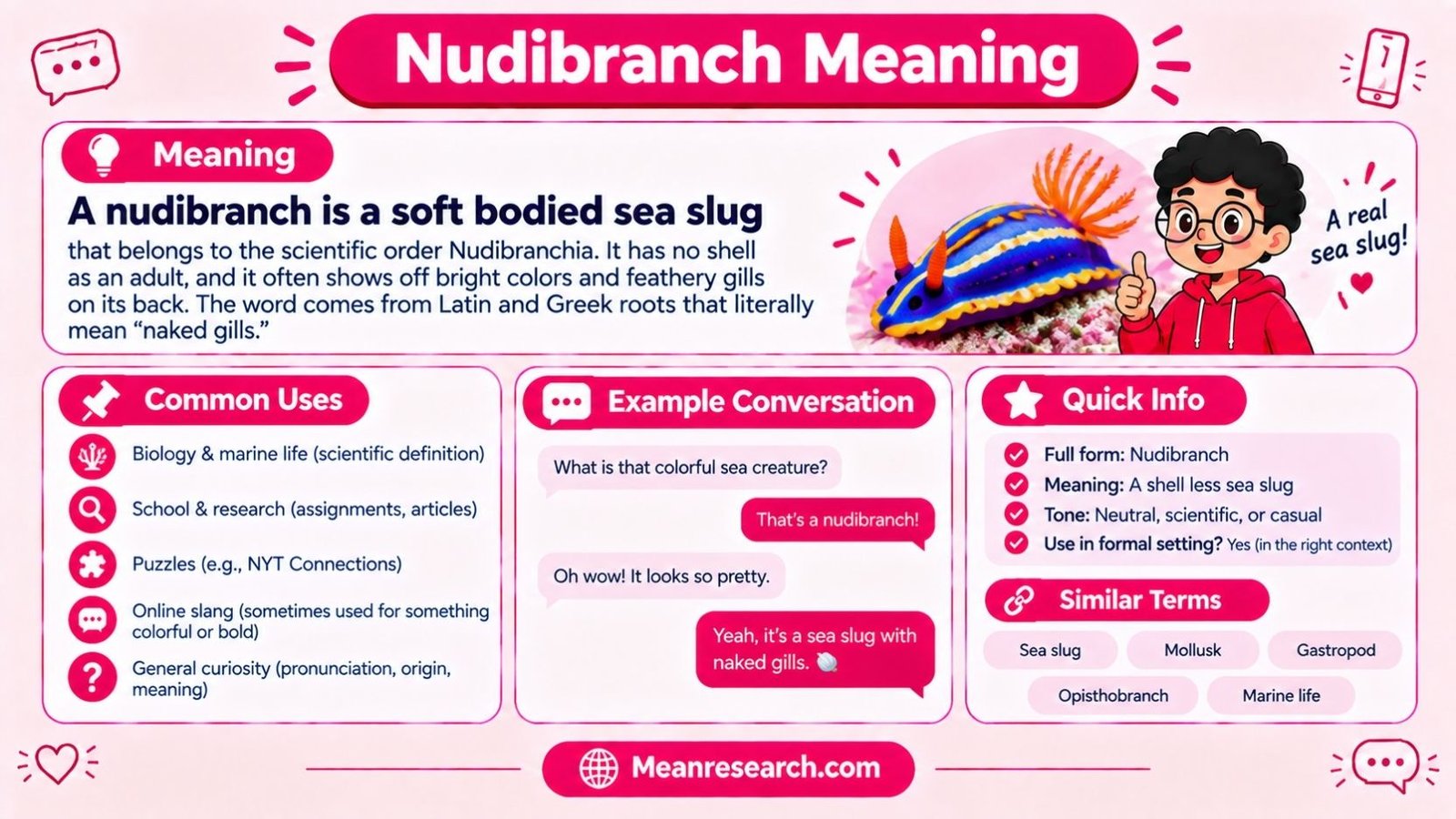
A nudibranch is a soft bodied sea slug that belongs to the scientific order Nudibranchia. It has no shell as an adult, and it often shows off bright colors and feathery gills on its back. The word comes from Latin and Greek roots that literally mean “naked gills,” which is exactly what the animal looks like up close.
People search for nudibranch meaning for more than one reason. Some want the biology definition. Others found the word in a puzzle, in a slang post, or in a science article and simply want a clear answer. This guide covers the real definition first, then walks through pronunciation, origin, slang use, and the puzzle connection that sends a lot of readers here in the first place.
What Does Nudibranch Mean?
In plain English, a nudibranch is a type of sea slug. It is a marine mollusk, which puts it in the same broad animal group as snails, clams, and octopuses. Unlike most mollusks, it does not carry a shell once it reaches adulthood.
Here is the core definition in a few clear points:
- Word: Nudibranch
- Part of speech: Noun
- Plural form: Nudibranchs
- Simple meaning: A shell less marine sea slug known for bright colors and exposed, gill-like structures on its body
- Scientific meaning: Any marine gastropod belonging to the order Nudibranchia
Merriam-Webster defines a nudibranch as any of an order of marine mollusks that have no shell in the adult stage and lack true gills in the way other mollusks have them. Dictionary.com and Collins English Dictionary describe it the same way, calling it a shell less marine snail with external, often branched breathing structures on its back and sides.
So when someone asks what nudibranch means, the short answer is simple: it means sea slug, specifically one from the Nudibranchia order.
Read More: S Meaning
Nudibranch Pronunciation
Getting the pronunciation right helps you say the word with confidence.
- Simple pronunciation: NOO-dih-brank
- IPA: /ˈnjuː.dɪ.bræŋk/ (British) or /ˈnuː.dɪ.bræŋk/ (American)
- Syllables: nu‑di‑branch (3 syllables)
- Stress: on the first syllable, “NU”
The tricky part for most readers is the ending. It is not pronounced like the tree part “branch” with a soft ending. It rhymes with “plank” or “bank.” Say it as one smooth word: NOO-dih-brank.
Nudibranch Word Origin And Etymology
The word nudibranch has a clean, literal origin. It comes from two older languages.
| Root | Language | Meaning |
| Nudus | Latin | Naked |
| Brankhia (βράγχια) | Ancient Greek | Gills |
Put those two pieces together and you get “naked gills.” That name describes the animal perfectly. Most nudibranchs breathe through feathery structures on their back that sit out in the open, unprotected by a shell, instead of tucked safely inside a shell like a snail’s gills would be.
The English word entered use through French, as “nudibranche,” sometime between 1835 and 1845, according to Collins English Dictionary and Dictionary.com. Scientists studying newly classified sea slugs needed a name that captured the animal’s most obvious feature, and “naked gills” fit.
Nudibranch Meaning In Biology
Now that you have the definition and origin, here is what makes a nudibranch a nudibranch in the eyes of marine biologists.
Key Features
- No shell as an adult. Young nudibranchs may have a small shell, but they lose it as they mature.
- External gills or gill like structures. Many species carry feathery or finger shaped appendages on their back, which is where the “naked gills” name comes from.
- Bright, often vivid coloring. Colors can act as camouflage, as a warning to predators, or as a byproduct of the food the animal eats.
- Sensory tentacles called rhinophores. These sit near the head and help the animal detect chemicals in the water, similar to a sense of smell.
- Carnivorous diet. Nudibranchs eat sponges, anemones, barnacles, and sometimes other nudibranchs.
- Hermaphroditic biology. Most nudibranchs have both male and female reproductive organs.
Size And Range
Nudibranchs vary a lot in size. Most species measure well under an inch, while a few larger types can grow past 20 centimeters. They live in oceans worldwide, from Arctic waters to tropical reefs to the icy Southern Ocean near Antarctica.
Roughly 3,000 species have been described so far, according to the Ocean Portal and Wikipedia’s marine biology references, and new ones are still being discovered. In 2024, researchers even described the first known nudibranch that lives in the deep ocean’s midnight zone, a species called Bathydevius that can glow through bioluminescence.
Nudibranch Vs Sea Slug: Are They the Same?
This is one of the most common points of confusion, so it deserves a direct answer.
Every nudibranch is a sea slug, but not every sea slug is a nudibranch.
“Sea slug” is a broad, informal term for many shell less marine mollusks. Nudibranchs are one specific, well known group within that larger category. Other sea slugs, such as the photosynthetic Sacoglossa or the colorful Aglajidae, look similar but belong to different taxonomic groups and are not true nudibranchs.
| Term | What It Covers |
| Sea slug | A general, informal name for many shell-less marine mollusks |
| Nudibranch | A specific scientific order (Nudibranchia) within that group |
If you are talking casually, calling any shell less marine slug a “nudibranch” is common, even among divers. If you want to be scientifically precise, only use the word for animals that actually belong to the order Nudibranchia.
Read More: Well Noted Meaning
Nudibranch Meaning In Slang
Outside of biology, the word occasionally shows up online in informal, non scientific ways. It helps to know this usage is not standard dictionary English. It comes from internet communities, not from an established source like Merriam-Webster or Oxford.
Two different informal uses show up:
- A playful description of style. In some online fashion and aesthetic circles, people have borrowed the word to describe something extremely colorful, bold, or eye catching, echoing the animal’s neon appearance. Someone might call an outfit or a photo “nudibranch” as a joking compliment about its vivid, almost over the top color palette.
- A crude wordplay entry on crowdsourced slang sites. User submitted sites like Urban Dictionary also host joke definitions that play on the sound of the word “nudi,” unrelated to marine biology. These entries are user generated, vary widely in tone, and are not something you would find in a standard dictionary.
💡 Tip: If you see “nudibranch” used outside of a science context, check the surrounding conversation. In most everyday writing, news articles, and educational content, it simply refers to the sea slug. The slang usage is limited to casual online spaces and is not something style guides or dictionaries recognize as an official secondary meaning.
Nudibranch Meaning In NYT Connections
If you searched for “groot nudibranch meaning,” “strunk nudibranch meaning,” or “nudibranch meaning connections,” you likely ran into the New York Times word game Connections, not a new dictionary definition.
In the Connections puzzle for June 29, 2026 (game number 1114), one purple category was titled “Ending in Parts of a Tree.” The four answer words were:
| Puzzle Word | Hidden Tree Part |
| Embark | Bark |
| Groot | Root |
| Nudibranch | Branch |
| Strunk | Trunk |
The puzzle grouped these four words because each one ends with a part of a tree once you drop the letters at the front. Nudibranch ends in “branch,” which made it the connecting piece for that day’s purple, hardest category. Groot refers to the tree-like Marvel character from Guardians of the Galaxy, and Strunk is a surname, most famously linked to William Strunk Jr., co-author of The Elements of Style.
So if you landed here from a puzzle, the answer is straightforward: nudibranch was chosen for its ending, “branch,” not because the word has a hidden puzzle related definition of its own. The sea slug meaning stays exactly the same.
Synonyms And Related Words
A few words overlap with nudibranch, though each carries a slightly different meaning.
| Word | Meaning | Difference From Nudibranch |
| Sea slug | General term for shell less marine mollusks | Broader category; nudibranch is one specific group within it |
| Opisthobranch | Older, broader scientific grouping that once included nudibranchs | A wider historical classification, less specific than nudibranch |
| Mollusk | Any animal in the phylum Mollusca, including snails, clams, and octopuses | Much broader; nudibranchs are just one small part of this phylum |
| Gastropod | Any snail or slug type mollusk with a single foot | Broader group; all nudibranchs are gastropods, but not all gastropods are nudibranchs |
The closest true synonym in everyday writing is “sea slug.” Use it when you want a simple, widely understood term. Use “nudibranch” when precision matters, such as in a science article or a marine biology discussion.
Common Mistakes
A few small mix ups come up often with this word.
❌ Incorrect: Calling every sea slug a nudibranch.
✅ Correct: Nudibranchs are a specific type of sea slug, not the only type.
❌ Incorrect: Pronouncing the ending like the word “branch” in “tree branch,” with a soft trailing sound.
✅ Correct: The ending is pronounced like “brank,” rhyming with “bank.”
❌ Incorrect: Assuming nudibranchs have shells.
✅ Correct: Nudibranchs lack a shell once they reach adulthood, which is central to their definition.
❌ Incorrect: Treating the internet slang usage as an official dictionary meaning.
✅ Correct: The informal, style-related usage is internet slang only. Standard dictionaries define nudibranch strictly as the marine animal.
Examples Of Nudibranch In A Sentence
A few natural examples show how the word fits into real writing:
- The diver spotted a bright orange nudibranch clinging to the coral reef.
- Marine biologists have described nearly 3,000 species of nudibranch worldwide.
- Unlike snails, a nudibranch has no shell once it becomes an adult.
- Photographers love nudibranchs because their colors make for striking underwater shots.
Read More: IONK Meaning
Frequently Asked Questions
What does nudibranch mean?
A nudibranch is a soft bodied, shell less sea slug from the order Nudibranchia, known for its bright colors and external gill like structures.
How do you pronounce nudibranch?
Say it as NOO-dih-brank, with the stress on the first syllable. The ending rhymes with “bank,” not with the tree word “branch.”
Is nudibranch a noun or a verb?
Nudibranch is a noun. It names an animal and has no verb form.
What is the plural of nudibranch?
The plural is nudibranchs, formed the regular way by adding an s.
Where does the word nudibranch come from?
It comes from Latin “nudus,” meaning naked, and Greek “brankhia,” meaning gills. Together they mean “naked gills,” describing the animal’s exposed breathing structures.
Is a nudibranch the same as a sea slug?
Not exactly. Every nudibranch is a sea slug, but sea slug is a broader term that also includes other, unrelated groups of shell less mollusks.
Why do people search for groot and strunk with nudibranch?
Those searches usually come from a New York Times Connections puzzle. The category grouped Embark, Groot, Nudibranch, and Strunk because each word ends in a part of a tree: bark, root, branch, and trunk.
Does nudibranch have a slang meaning?
Only informally. Some online communities use it playfully to describe something extremely colorful or eye catching, based on the animal’s vivid appearance. This is internet slang, not a standard dictionary definition.
Do all nudibranchs have shells?
No. A defining feature of the group is the lack of a shell in adulthood, even though some very young nudibranchs may briefly carry one.
What is a good synonym for nudibranch?
Sea slug is the most common and widely understood synonym, though it is a broader term than nudibranch.
Conclusion
Nudibranch meaning comes down to one clear idea: a shell less, often brightly colored sea slug from the order Nudibranchia, named from Latin and Greek words that literally translate to “naked gills.” The definition has stayed consistent across major dictionaries, and the word describes a real, well studied group of marine animals found in oceans around the world.
Whether you arrived here through a biology question, a curiosity about pronunciation, an internet slang post, or a New York Times Connections puzzle, the answer stays the same. The scientific meaning is the accurate one to use in writing, conversation, and research, while the playful online usage remains a separate, informal offshoot that has not entered standard English.

Hooriya Salman is the writer and researcher behind Mean Research, with 4 years of experience researching and writing about word meanings, slang, names, and everyday language. Their aim is to provide clear, accurate, and easy-to-understand explanations that help readers discover the meaning behind unfamiliar words, expressions and names.
One Comment