
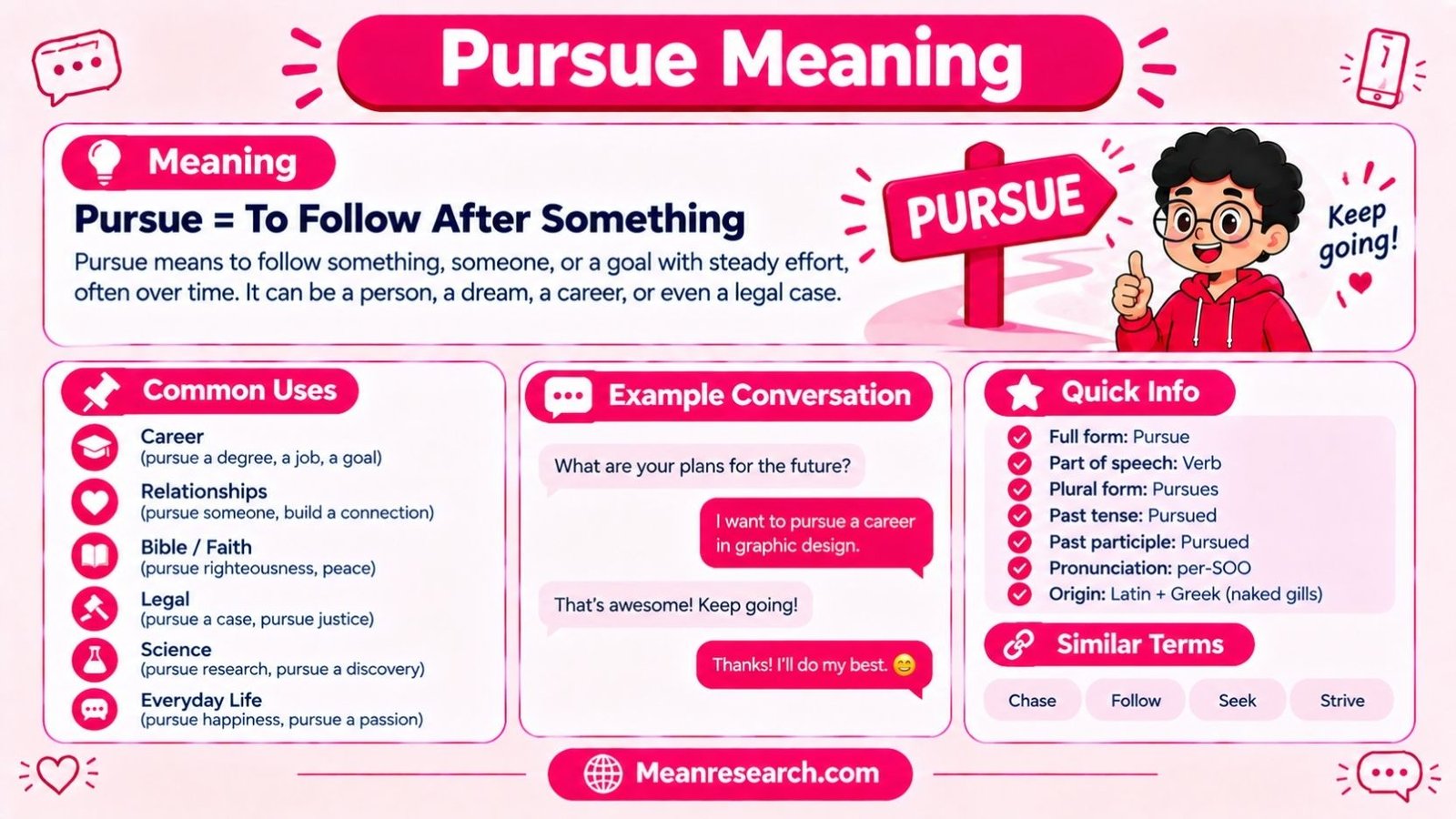
If you have ever seen the word “pursue” and paused for a second, you are not alone. It looks simple, but it carries more weight than most people expect. At its core, pursue means to follow something, someone, or some goal with steady effort, often over time.
You will see it in job applications, in Bible verses, in court documents, in text messages about relationships, and in everyday conversation about life goals. The meaning shifts slightly depending on where you find it, but the heart of the word stays the same: continued effort toward something you want.
This guide breaks down every common way people search for and use “pursue,” from grammar basics to emotional context, so you leave with a clear, confident understanding.
Many readers land here after typing something like “what do you pursue meaning” or “i want to pursue meaning” into a search bar. Others want to know if “persue” is a real spelling, or how the word shows up in the Bible or in law. This article answers all of that in one place, in plain English.
Pursue Meaning: The Simple Definition
Pursue means to follow after something in order to reach, achieve, or catch it. It can describe a physical chase, like a police car pursuing a suspect, or a mental and emotional effort, like pursuing a career or pursuing happiness.
The word works as a verb. It needs a subject and, almost always, an object: a person pursues something or someone.
Here is the core idea in one line:
Pursue = to go after something with continued effort, over time, because you want to reach it.
That single definition covers most of what people mean when they search this word, whether the context is love, law, faith, career, or daily life.
Read More: Nudibranch Meaning
Pursue: Part of Speech and Basic Grammar
“Pursue” is a verb. It is a regular verb in most respects, though its spelling shifts slightly in certain forms because of the silent “e” at the end.
| Form | Word | Example |
| Base form | pursue | They pursue new customers every quarter. |
| Third person singular | pursues | She pursues her goals with discipline. |
| Past tense | pursued | He pursued a medical degree for six years. |
| Past participle | pursued | The suspect was pursued for three miles. |
| Present participle | pursuing | I am pursuing a master’s degree part time. |
Notice that the past tense and past participle are the same: pursued. This makes the verb a regular verb, unlike irregular verbs such as “go” or “run.”
Pursue As A Transitive Verb
Pursue is almost always transitive, meaning it needs a direct object. You do not simply “pursue.” You pursue something.
- Correct: She pursued a career in law.
- Incorrect on its own: She pursued. (This sentence feels incomplete without an object.)
This matters for grammar accuracy, especially in formal writing, resumes, and legal documents.
Persue Or Pursue: Which Spelling Is Correct?
This is one of the most common mix-ups searched online, and the answer is simple.
Pursue is the correct spelling. “Persue” is a misspelling.
There is no dictionary, formal or informal, that lists “persue” as a standard alternative spelling in modern English. The error usually happens because people hear the word and guess at the spelling, swapping the “u” and “e” placement.
| Spelling | Status |
| Pursue | ✅ Correct |
| Persue | ❌ Incorrect |
| Persu | ❌ Incorrect |
| Pursu | ❌ Incorrect |
💡 Tip: If you tend to mix this up, remember that “pursue” contains the word “purse.” Both start with p, u, r, s. That small memory trick can help lock in the correct order.
How To Pronounce Pursue
Pursue is pronounced per-SOO, with the stress on the second syllable.
- IPA (American English): /pərˈsuː/
- Simple phonetic spelling: per-SOO
The first syllable is soft and quick, almost like the word “per” in “person.” The second syllable carries the emphasis and rhymes with words like “too” and “shoe.”
There is no meaningful difference in pronunciation between American and British English for this word. Both use the same stress pattern and vowel sounds.
Origin And Etymology Of Pursue
The word pursue has a long history that stretches back through French into Latin.
It entered English from Old French, where forms such as porsuir and poursivre meant to chase or follow after. That Old French word developed from Vulgar Latin prosequere, a variation of the Latin verb prosequi, which combined pro- (forward) and sequi (to follow).
So at its linguistic root, pursue literally means “to follow forward.” That original sense of forward movement toward a target has survived into modern English almost unchanged, whether the target is a criminal, a career, or a relationship.
The related noun “pursuit” and the legal term “pursuant” share this same Latin root, which is why they all carry a sense of following, chasing, or acting in accordance with something.
Pursue Meaning In Different Contexts
The dictionary definition of pursue stays fairly stable, but the feeling and stakes behind the word change a lot depending on where it appears. Below are the contexts people search for most.
Pursue Meaning In Love And Relationships
In a romantic context, to pursue someone means to actively show interest, make effort, and work to build a connection with that person. It is not passive. It involves initiating contact, planning time together, and communicating genuine interest over time.
When someone says “he is pursuing me” or “I want to pursue this relationship,” they usually mean one of these things:
- Making consistent effort to spend time with the person
- Communicating clear romantic interest, not mixed signals
- Following through with actions, not just words
- Showing patience and consistency instead of a single grand gesture
Many relationship writers and dating coaches describe healthy pursuit as steady and respectful, not aggressive or one sided. A person who pursues someone in a healthy way respects boundaries and pays attention to whether the interest is mutual.
📌 Note: Pursuit in dating is generally described as a two way process over time. One person showing effort while the other shows none is usually described as an imbalance, not genuine mutual pursuit.
Read More: TS Meaning Slang
Pursue Meaning In The Bible
The word pursue appears many times throughout the Bible, most often in the Old Testament, where it frequently describes armies chasing enemies or people pursuing a spiritual quality.
Two well known biblical uses include the instruction to pursue peace and the instruction to pursue righteousness or love. For example, several English Bible translations use the word pursue in verses that encourage believers to actively chase after good character, peace with others, and a right relationship with God, rather than waiting passively for these things to happen.
In this religious context, pursue carries a strong sense of intentional, ongoing effort. It is not a one time decision. It describes a continuous, daily choice to move toward a spiritual goal.
Because Bible translations vary, the exact wording of any specific verse can differ between versions such as the King James Version, the New International Version, and others. If you are looking for an exact verse, it is best to check a specific translation directly, since word choice can shift from one Bible version to another.
Vigorously Pursue Meaning In State Court Cases
In legal writing, the phrase “vigorously pursue” shows up often in court filings, judgments, and legal commentary. It means to actively, energetically, and persistently follow through with a legal claim, case, or remedy, rather than letting it sit inactive.
Courts and attorneys use this phrase to describe a party who is not being passive about their legal rights. For example, a plaintiff who “vigorously pursues” a claim is one who files motions, meets deadlines, gathers evidence, and pushes the case forward with real effort, instead of letting the matter stall.
State courts sometimes reference this phrase when evaluating whether a party acted in good faith or whether a case should be dismissed for lack of activity. The word “vigorously” intensifies the base meaning of pursue, adding emphasis on effort and speed.
In simpler terms:
- Pursue a case = work toward resolving it
- Vigorously pursue a case = work toward resolving it with strong, consistent, active effort
Pay And Pursue Meaning
“Pay and pursue” is a phrase most often found in insurance and financial contexts. It describes a situation where one party pays a claim or obligation first, and then pursues reimbursement or recovery from another responsible party afterward.
This term commonly appears in insurance claims. For instance, an insurer might pay a policyholder’s claim right away, then separately pursue the at fault party or their insurance company to recover the cost. The phrase reflects a two step process: pay now, chase repayment later.
This approach is often used to keep claims moving quickly for the person who needs the payout, while the responsibility for who ultimately covers the cost gets sorted out afterward.
Career Pursue Meaning
When people talk about pursuing a career, they mean actively working toward entering, building, or advancing in a specific professional field. This might include:
- Studying or training in that field
- Applying for relevant jobs or internships
- Building skills and experience over time
- Networking with people already working in that area
“I want to pursue a career in nursing” means the person is taking real steps, not just thinking about it casually. The verb signals action and direction, not idle interest.
How To Pursue Meaning In Life
This search often reflects something deeper than grammar. People asking “how do I pursue meaning in life” are usually asking a personal or philosophical question: how do I find and chase a life that feels purposeful?
While this guide focuses on language, it is worth noting the linguistic link. To “pursue meaning” in this sense combines the verb pursue with the noun meaning, referring to purpose, significance, or a sense of why your life matters. Common paths people describe include pursuing relationships, work that feels valuable, personal growth, faith, or contribution to others.
Grammatically, this phrase simply follows the standard pattern: subject + pursue + object (meaning). The emotional weight comes from what “meaning” represents to the individual, not from anything unusual in the sentence structure.
Common Translations Of “Pursue”
Because many readers search for this word in other languages, here is a quick reference table with widely recognized translations. Keep in mind that exact word choice can shift slightly depending on regional dialect and specific context.
| Language | Common Translation | Notes |
| Hindi | पीछा करना (peechha karna), अनुसरण करना (anusaran karna) | Meaning shifts between “to chase” and “to follow” depending on context |
| Urdu | پیچھا کرنا (peechha karna) | Same root sense as Hindi, common in spoken and written Urdu |
| Punjabi | ਪਿੱਛਾ ਕਰਨਾ (pichha karna) | Used in both formal and everyday speech |
| Chinese (Mandarin) | 追求 (zhuīqiú) | Very common for pursuing goals, dreams, or a romantic interest |
| Bengali | অনুসরণ করা (anusaran kôra) | General sense of following or chasing |
| Tamil | பின்தொடர (pin thodara) | Reflects the idea of following after |
| Telugu | వెంబడించు (vembadinchu) | Common translation for chase or follow |
| Malayalam | പിന്തുടരുക (pinthudaruka) | General sense of pursuing or following |
| Marathi | पाठलाग करणे (paathlaag karne) | Common in everyday Marathi usage |
| Farsi (Persian) | تعقیب کردن (ta’qib kardan) | Frequently used in both formal and legal Persian |
📌 Note: Translation always depends on context. A word used for “pursuing a career” in one language may differ from the word used for “pursuing a criminal” or “pursuing a romantic interest.” When precision matters, such as legal or academic writing, it is best to confirm the exact translation with a native speaker or professional translator.
Synonyms Of Pursue
Choosing the right synonym depends heavily on context. Below is a breakdown of common alternatives and how their meaning differs slightly from pursue.
| Word | Meaning | When It Fits Best |
| Chase | To run after someone or something quickly | Best for physical, fast movement, like chasing a bus |
| Follow | To go after or come after something | Softer and less intense than pursue |
| Seek | To try to find or obtain something | Fits goals, information, or opportunities |
| Strive | To make great effort to achieve something | Fits long term personal or professional goals |
| Chase after | Informal version of chase | Common in everyday speech |
| Go after | To actively try to get something | Casual, commonly used in spoken English |
| Continue | To keep something going without stopping | Fits ongoing actions, like continuing a plan |
| Prosecute | To pursue legally through court | Formal, legal context only |
None of these words are perfect one to one replacements. “Chase” feels faster and more urgent. “Seek” feels calmer and more exploratory. “Pursue” sits in the middle, carrying both intention and sustained effort.
Antonyms Of Pursue
- Abandon
- Give up
- Avoid
- Ignore
- Neglect
These words describe stopping or refusing effort, the opposite of the ongoing action that pursue implies.
Pursue Vs Pursuit Vs Pursuer
These three related words often get confused because they share the same root.
| Word | Part of Speech | Meaning |
| Pursue | Verb | To follow or go after something |
| Pursuit | Noun | The act or process of pursuing |
| Pursuer | Noun | A person who is pursuing something or someone |
Example sentences:
- Verb: She decided to pursue a new business idea.
- Noun (pursuit): Her pursuit of the idea took two years of planning.
- Noun (pursuer): The pursuer never slowed down, even as the trail grew cold.
Example Sentences Using Pursue
Real examples make the meaning click faster than definitions alone. Here are a few natural sentences across different contexts.
- The company plans to pursue new markets in Southeast Asia next year.
- After years of hesitation, she finally decided to pursue her passion for painting.
- Police pursued the vehicle for nearly ten minutes before it stopped.
- He chose to pursue a graduate degree instead of entering the workforce immediately.
- The team will pursue every legal option available to them.
Each sentence follows the same basic grammar pattern: someone (the subject) pursues something (the object), with a sense of continued or intentional effort.
Common Mistakes When Using Pursue
Even confident English speakers slip up with this word sometimes. Here are the most frequent mistakes and how to fix them.
❌ Incorrect: I will persue my dream job next year.
✅ Correct: I will pursue my dream job next year.
❌ Incorrect: She pursue her studies abroad.
✅ Correct: She pursues her studies abroad. (Third person singular needs the “s.”)
❌ Incorrect: They pursued of the criminal.
✅ Correct: They pursued the criminal. (No preposition needed after “pursued.”)
❌ Incorrect: He is pursue a career in medicine.
✅ Correct: He is pursuing a career in medicine. (Continuous tense needs “-ing.”)
⚠️ Common Mistake: Many learners add an unnecessary preposition after pursue, such as “pursue for” or “pursue after.” Standard English does not require this. Pursue already implies “after” within its own meaning, so the object follows the verb directly.
Read More: S Meaning
Frequently Asked Questions
What does pursue mean in simple words?
Pursue means to follow after something or someone in order to reach, achieve, or catch it, usually with ongoing effort over time.
Is pursue a noun or a verb?
Pursue is a verb. The related noun form is “pursuit,” and the person doing the action is called a “pursuer.”
Is persue a correct spelling of pursue?
No. “Persue” is a common misspelling. The correct and only standard spelling is “pursue.”
How do you pronounce pursue?
Pursue is pronounced per-SOO, with the stress placed on the second syllable.
What is the past tense of pursue? The past tense of pursue is “pursued.” This same form also works as the past participle.
What is a synonym for pursue?
Common synonyms include chase, follow, seek, and strive, though each carries a slightly different tone depending on the sentence.
What does it mean to pursue someone in a relationship?
It means actively showing romantic interest through consistent effort, communication, and follow through, rather than passive or mixed signals.
What does vigorously pursue mean in legal cases?
It means actively and persistently working to move a legal claim or case forward, with real effort rather than letting it sit inactive.
What is the difference between pursue and pursuit?
Pursue is the verb form describing the action. Pursuit is the noun form describing the process or state of pursuing.
Can pursue be used without an object?
Rarely. Pursue is almost always transitive, meaning it needs an object, such as a goal, a person, a career, or a case.
Final Thoughts
Pursue is a word built around forward motion and sustained effort. Whether it appears in a courtroom, a Bible verse, a job interview, or a quiet conversation about love, the core idea stays the same: someone is actively working toward something they want, rather than waiting for it to arrive on its own.
Understanding this word clearly helps in more places than grammar tests. It shapes how you write a resume, how you read a legal document, how you interpret a relationship, and how you think about your own goals. The next time you see or use the word pursue, you will know exactly what it is doing in the sentence, and why it carries the weight it does.

Hooriya Salman is the writer and researcher behind Mean Research, with 4 years of experience researching and writing about word meanings, slang, names, and everyday language. Their aim is to provide clear, accurate, and easy-to-understand explanations that help readers discover the meaning behind unfamiliar words, expressions and names.

2 Comments