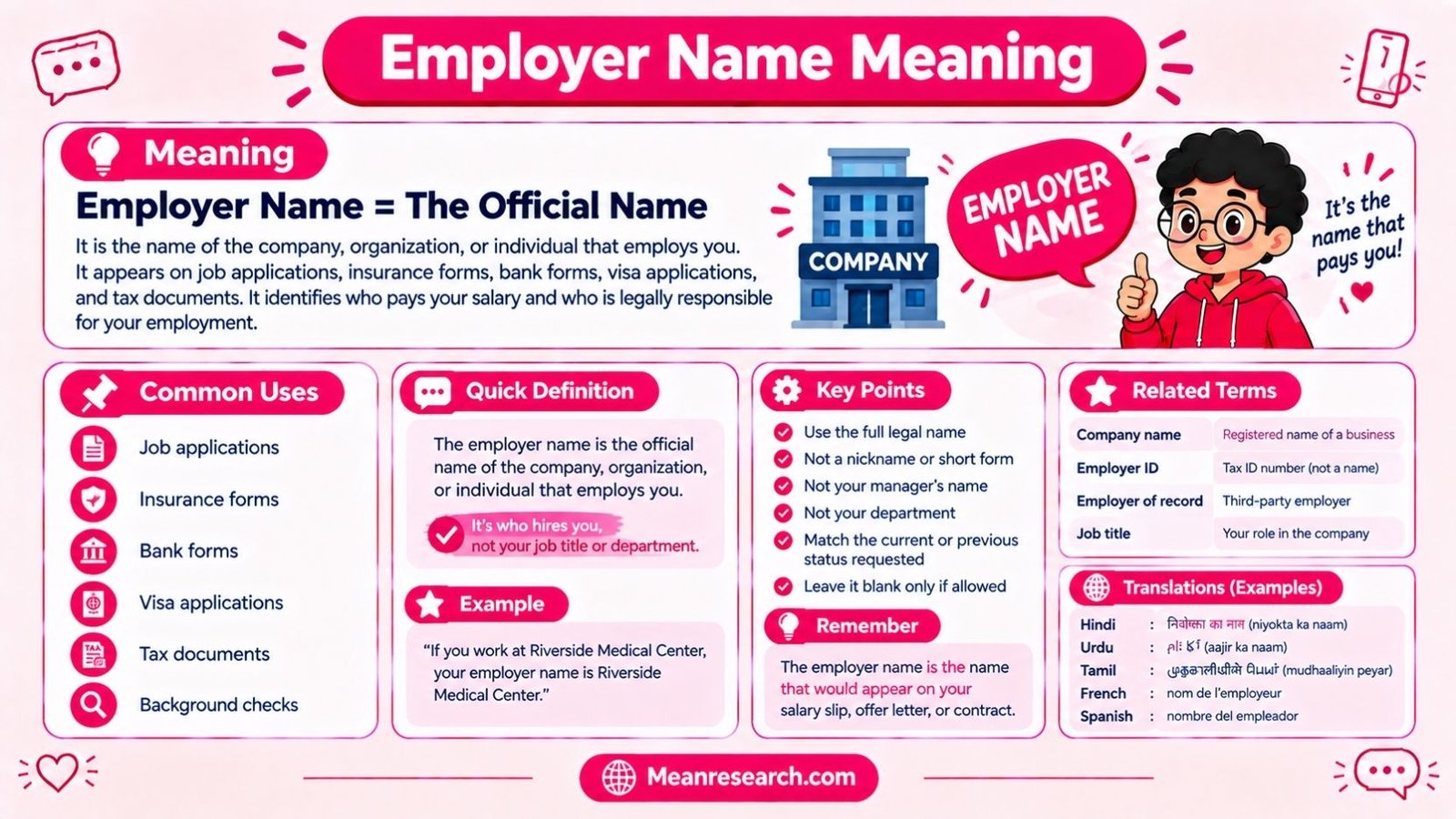
Employer name meaning is simple once you break it down: it is the official name of the company, organization, or individual that employs you. This name appears on job applications, insurance forms, bank forms, visa applications, and tax documents. It identifies exactly who pays your salary and who is legally responsible for your employment. In most cases, it is the full registered name of your workplace, not a nickname or short form.
Understanding this term matters more than it seems. Forms that ask for your employer name are often used for background checks, income verification, insurance coverage, and legal record keeping. Writing the wrong name, an outdated name, or an informal name can cause delays or rejections. Knowing exactly what the field expects, and how to answer it correctly, saves time and avoids confusion later.
What Does Employer Name Mean?
“Employer name” refers to the identity of the person or organization that hires and pays someone for their work. It is not the job title, the department, or the industry. It is specifically the name that identifies the employing entity.
In practical terms, this could be:
- A company, such as “Microsoft Corporation” or “Tata Consultancy Services Limited”
- A government body, such as “Department of Health and Human Services”
- A school, hospital, or nonprofit organization
- A sole proprietor or individual business owner, if that person directly employs staff
The key idea stays the same across all contexts. Employer name always points to who is legally responsible for the job, the paycheck, and the working relationship.
Read More: TBD Meaning
Employer Name Meaning: Simple Definition
Here is a plain, one-line way to understand it.
| Term | Simple Meaning |
| Employer | The person or organization that hires and pays someone to work |
| Employer name | The official name used to identify that person or organization on forms and documents |
| Employer name field | A blank space on a form where you write your employer’s registered or official name |
Think of it this way: if someone asks, “Who do you work for?” your answer is your employer name.
Employer Name Meaning Example
Examples make this clearer than a definition alone.
- If you work as a nurse at City General Hospital, your employer name is “City General Hospital.”
- If you work as a software developer for a company called Bright Path Technologies Inc., your employer name is “Bright Path Technologies Inc.,” not “the tech company” or “my office.”
- If you are self-employed and run your own consulting business under the name “Clearline Consulting,” that becomes your employer name, since you are both the worker and the business owner.
A good rule to remember: the employer name is the name that would appear on your salary slip, offer letter, or employment contract.
Current Employer Name Meaning
“Current employer name” asks for the name of the company or organization where you work right now, at the time you are filling out the form. This is one of the most common versions of the question, and it appears on job applications, loan forms, credit card applications, and background check forms.
If you are actively employed, this is straightforward. You write the name of the organization paying your current salary. If you are unemployed, a student, or between jobs, most forms include an option such as “Not Applicable,” “Unemployed,” or “Currently Not Employed,” so you are not forced to invent an answer.
💡 Tip: Always use the full legal or registered name of the company, not a shortened brand name, unless the form specifically allows abbreviations.
Present Employer Name Meaning
“Present employer name” means exactly the same thing as “current employer name.” Both phrases ask for the name of the organization you are working for today. Some forms use “current,” others use “present,” and a few older or formal documents may say “existing employer.” There is no meaningful difference in intent between these versions.
Previous Employer Name Meaning
“Previous employer name” refers to the company or organization you worked for before your current job, or before the job you are describing on the form. This is common on résumés, employment verification forms, and background check documents that ask for work history.
For example, if you worked at Greenfield Marketing Solutions for three years and then moved to a new company, Greenfield Marketing Solutions becomes your “previous employer” on any form you fill out afterward.
Some forms ask for more than one previous employer, especially when checking a five-year or ten-year work history. In that case, each past employer name should be listed separately, usually with the job title and employment dates included.
Your Employer Name Meaning
When a form says “your employer name,” it is simply asking you, the person filling out the form, to state who your employer is. The word “your” here is not part of a special term. It is just a direct way of personalizing the question so you understand it applies to you specifically, not to a spouse, parent, or another applicant listed on the same form.
This phrasing appears often on:
- Loan and credit applications
- Visa and immigration forms
- Insurance applications
- Rental and lease agreements
Insured Employer Name Meaning
On insurance documents, “insured employer name” refers to the employer of the person who holds the insurance policy, particularly when the coverage is connected to that person’s job. This phrase is common on health insurance forms, group insurance policies, and workers’ compensation documents.
Many insurance plans are offered through employers as a workplace benefit. In that case, the insurance company needs to know which employer is providing or sponsoring the coverage. This helps verify eligibility and connects the policy to the correct group plan.
Example: If your health insurance is provided through your job at Northbridge Logistics, then “Northbridge Logistics” is the insured employer name on your policy documents.
Policy Holder Employer Name Meaning
This phrase narrows the question further. It asks specifically for the employer of the policyholder, meaning the person who owns or holds the insurance policy, rather than a dependent listed under that policy.
This distinction matters on family insurance plans. A policy might cover a spouse and children, but only the policyholder’s employer is relevant here, since the coverage is usually tied to that person’s job benefits.
Spouse Employer Name Meaning
“Spouse employer name” asks for the name of the company or organization where your husband or wife works. This question appears on joint loan applications, family insurance forms, visa applications for couples, and household income verification documents.
It exists because many financial and insurance decisions consider household income and benefits as a whole, not just one person’s job. If a form has a separate line for “applicant employer name” and “spouse employer name,” fill in each one with the correct person’s employer, not both with the same answer unless you and your spouse genuinely work at the same organization.
Read More: Pursue Meaning
Principal Employer Name Meaning
“Principal employer” is a more specific legal term, most often used in labor and contract law, particularly in South Asian employment regulations. It refers to the owner or main organization responsible for a workplace, especially when contract workers or outsourced staff are involved.
For example, if a factory hires cleaning staff through a staffing agency, the factory itself is usually considered the “principal employer,” while the staffing agency acts as the “contractor” or intermediate employer. The principal employer name identifies the main establishment legally accountable for the workplace, even though day-to-day management of certain workers may be handled by a contractor.
This term is common on labor compliance forms, provident fund documents, and contract labor registration paperwork.
Employer Name In Different Languages
Many readers search for this term in regional languages, especially when filling out multilingual government or insurance forms. Below are commonly used translations. Exact wording can vary slightly by region, dialect, or form style, so always match the language used on your specific document when possible.
| Language | Common Term for “Employer Name” |
| Hindi | नियोक्ता का नाम (niyokta ka naam) |
| Telugu | యజమాని పేరు (yajamaani peru) |
| Tamil | முதலாளியின் பெயர் (mudhaaliyin peyar) |
| Marathi | नियोक्त्याचे नाव (niyoktyaache naav) |
| Gujarati | નોકરીદાતાનું નામ (nokaridaatanu naam) |
| Urdu | آجر کا نام (aajir ka naam) |
| Bengali | নিয়োগকর্তার নাম (niyogkortar naam) |
| Malayalam | തൊഴിലുടമയുടെ പേര് (thozhiludamayude peru) |
| Kannada | ಉದ್ಯೋಗದಾತರ ಹೆಸರು (udyogadaatara hesaru) |
| Tagalog | Pangalan ng employer, or pangalan ng nagpapatrabaho |
⚠️ Note: Government and legal forms in these languages sometimes use slightly different official phrasing depending on the country or department. If you are filling out an official document, it is best to match the exact term printed on that form rather than relying only on a general translation.
How To Fill “Employer Name” Correctly On A Form
Getting this field right avoids unnecessary follow-up questions or delays. Use this simple approach.
- Use the full legal name. Write the company’s official registered name, not a nickname, abbreviation, or the name of a parent brand unless instructed otherwise.
- Check your pay slip or offer letter. Your correct employer name usually appears there exactly as it should be written.
- Avoid personal titles. Do not write your manager’s name or your department. The field asks for the organization, not a person, unless you are self-employed.
- Match the current status requested. If the form says “current,” give your present employer. If it says “previous,” give your last job before that.
- Leave it blank only if allowed. If you are unemployed, retired, or a student, check whether the form provides an appropriate option instead of guessing an answer.
Employer Name Vs Related Terms
These terms are often confused with each other. Here is how they differ.
| Term | Meaning | Example |
| Employer name | Name of the organization or person who employs you | “Bright Path Technologies Inc.” |
| Company name | The registered name of a business, which may or may not be your employer | “Bright Path Technologies Inc.” (same if you work there) |
| Employer identification number | A tax ID number assigned to a business by a government tax authority | A unique number, not a name |
| Employer of record | A third-party organization that legally employs staff on behalf of another company | Used in outsourcing and global hiring |
| Job title | Your specific role or position within the company | “Marketing Manager” |
Common Mistakes
Small errors in this field are common. Here are a few worth avoiding.
❌ Incorrect: Writing “self” or “own business” without naming the actual business.
✅ Correct: Writing the registered business name, even for a small or self-owned company.
❌ Incorrect: Using a nickname like “the bank” instead of the full name, such as “First National Bank.”
✅ Correct: Using the complete official name as it appears on employment documents.
❌ Incorrect: Leaving the field blank without checking if the form requires a specific unemployed status.
✅ Correct: Selecting “Not Applicable” or “Unemployed” if the form provides that option.
Read More: Nudibranch Meaning
Frequently Asked Questions
What does employer name mean?
It means the official name of the company, organization, or individual that employs a person and pays their salary.
What is an example of an employer name?
If someone works at “Riverside Medical Center,” then “Riverside Medical Center” is their employer name.
Is employer name the same as company name?
Usually yes, if the company employs you directly. It can differ if you work through a staffing agency, in which case the agency may be listed as the employer instead of the company where you physically work.
What should I write if I am self-employed?
Write the registered name of your own business. If you do not have a separate business name, some forms allow “Self-employed” as an answer.
What does spouse employer name mean on a form?
It asks for the name of the company or organization where your husband or wife works, not your own employer.
What is principal employer name?
It refers to the main organization legally responsible for a workplace, especially when contract or outsourced workers are involved.
How do I write employer name in Hindi?
The common phrase used is नियोक्ता का नाम (niyokta ka naam).
Should I use an abbreviation or the full company name?
Use the full legal name unless the form specifically allows short forms or common abbreviations.
What if I have never been employed?
Look for an option such as “Not Applicable” or “No prior employment.” If none exists, it is acceptable to state that clearly in the field rather than leaving it empty.
Conclusion
Employer name meaning comes down to one clear idea: it identifies the organization or person responsible for your job and your paycheck. Whether a form asks for your current employer, previous employer, spouse’s employer, or the principal employer under labor law, the underlying question stays the same. It wants the correct, official name of the employing party, written accurately and completely.
Getting this detail right matters more than it first appears, since insurance approvals, loan processing, and background checks often depend on accurate employer information. When filling out any form, take a moment to confirm the exact legal name of the employer involved, match it to the specific version of the question being asked, and avoid shortcuts like nicknames or incomplete names. A little care here prevents unnecessary delays later.

Hooriya Salman is the writer and researcher behind Mean Research, with 4 years of experience researching and writing about word meanings, slang, names, and everyday language. Their aim is to provide clear, accurate, and easy-to-understand explanations that help readers discover the meaning behind unfamiliar words, expressions and names.

2 Comments