
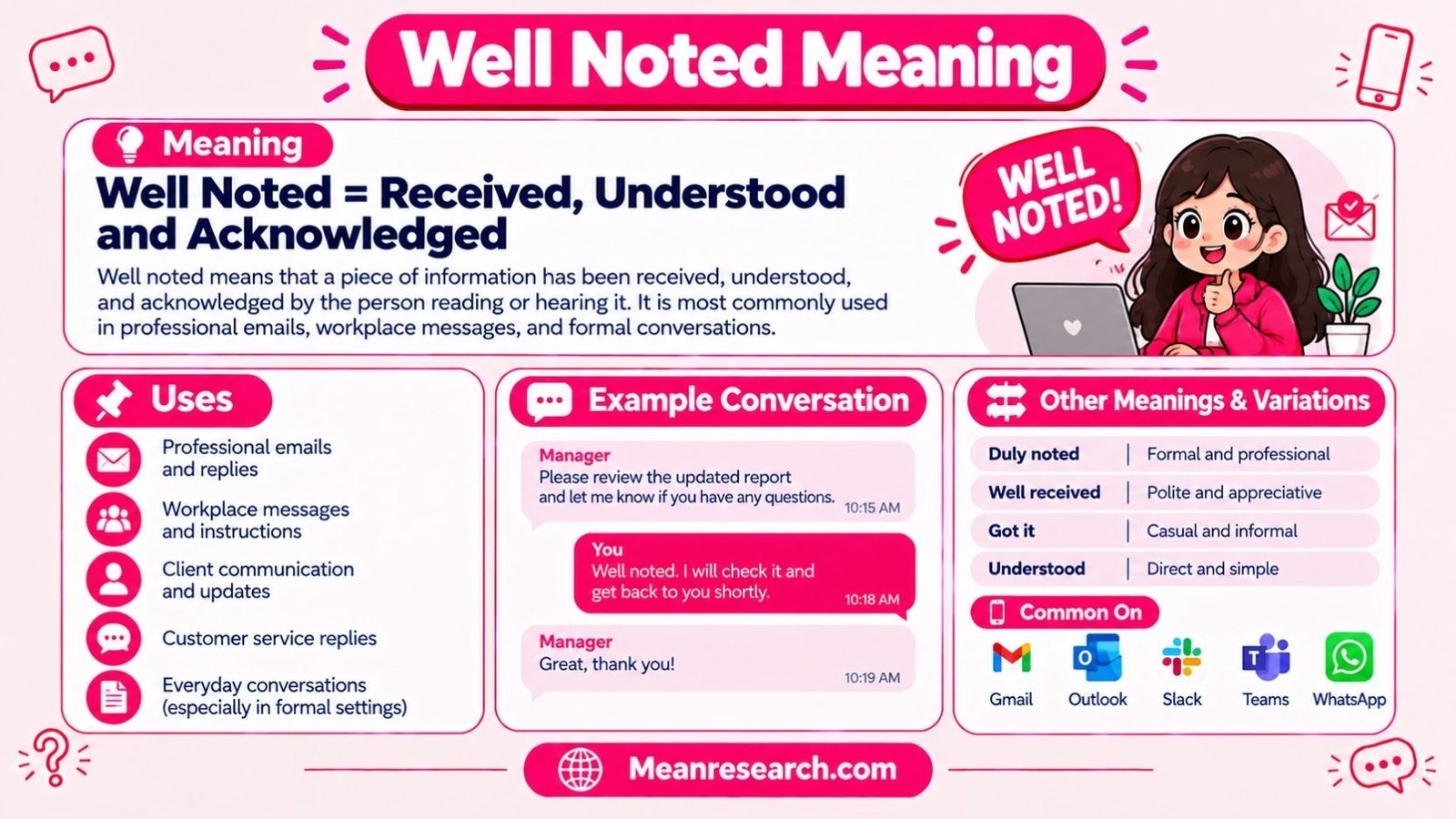
Well noted means that a piece of information has been received, understood, and acknowledged by the person reading or hearing it. It is most commonly used in professional emails, workplace messages, and formal conversations to confirm that instructions, updates, or feedback have registered with the recipient. In short, saying “well noted” is a polite, professional way of saying “I understand, and I have taken this on board.”
This phrase shows up constantly in office emails, client communication, customer service replies, and even everyday conversation across English-speaking and non-native English-speaking workplaces alike.
Yet many people are unsure whether it sounds natural, whether it is grammatically correct, or whether there is a better way to say the same thing. This guide answers all of that, plus the meaning of “well noted” in several widely searched languages, common variations like “duly noted” and “well received,” and real example sentences you can use immediately.
What Does “Well Noted” Mean?
“Well noted” is a short acknowledgment phrase. It tells the sender of a message that their point, instruction, request, or piece of information has been read, understood, and stored in the recipient’s mind for future reference or action. It does not necessarily mean agreement it simply confirms that the message has landed and been registered.
The phrase is made up of two parts. “Noted” on its own already means “recorded” or “taken note of.” Adding “well” in front of it is an intensifier, meant to add a touch of warmth, respect, or emphasis, similar to how “well done” adds weight to “done.” Together, the phrase reads as a slightly softer, more courteous version of a plain “noted.”
Quick Definition Box
| Element | Explanation |
| Core meaning | Message received, understood, and acknowledged |
| Tone | Polite, professional, slightly formal |
| Common use | Email replies, workplace instructions, client updates |
| Implies agreement? | No only acknowledgment, not necessarily approval |
| Grammatical role | Short interjection or sentence fragment, used as a standalone reply |
Read More: Stay Tuned Meaning
Is “Well Noted” Grammatically Correct?
This is one of the most common questions people ask, and the honest answer is: it depends on context. As a standalone reply on its own, just “Well noted.” As a full sentence, it functions as an idiomatic fragment, similar to “Sounds good” or “Understood.” It is widely accepted in business English even though it is not a complete grammatical sentence in the traditional sense.
However, some style guides and grammar-conscious writers consider “well noted” slightly awkward because “well” more naturally modifies verbs of action (“noted well,” “he explained it well”) rather than sitting in front of a past participle used as an acknowledgment. That said, common usage in global business emails has firmly established “well noted” as acceptable, especially when it’s expanded into a fuller sentence.
Note: If you want a version that grammar purists universally accept, “Noted, thank you” or “This has been noted” are safer bets. But “Well noted” is now so widely used in professional emails worldwide that it reads as completely normal to almost every reader.
Well Noted Meaning In An Email
In email communication, “well noted” is typically used to confirm that you have received and understood information such as a deadline, a change in plans, a client request, feedback on your work, or instructions from a manager. It is a way of closing the loop so the sender knows their message did not get lost or ignored.
Using it in an email signals professionalism and attentiveness. It reassures the other person that you are on the same page, without requiring you to write out a long explanation. Because email threads move fast in most workplaces, a short and clear acknowledgment like this keeps communication efficient.
Example Email Usage
Subject: Re: Revised Project Timeline
Hi Sarah,
Well noted on the new deadline of March 15th. I will adjust the team’s schedule accordingly and send an updated plan by tomorrow.
Best regards, James
More Email Sentence Examples
- “Your email is well noted, and I will follow up with the vendor today.”
- “Well noted, thank you for the update. I’ll make the necessary changes.”
- “Point well noted. I will revise the report and resend it by Friday.”
- “This is well noted. Please let me know if there are any further changes.”
- “Message well noted. We will proceed as discussed in the call.”
“This Is Well Noted” vs. “Well Noted” Is There a Difference?
Both phrases carry the same core meaning, but they differ slightly in tone and formality.
| Phrase | Tone | Best Used When |
| Well noted | Brief, efficient, slightly informal | Quick replies, internal team chats, casual professional tone |
| This is well noted | Slightly more formal and complete | Client emails, formal reports, situations needing a fuller sentence |
| It’s well noted | Conversational, contracted form | Spoken English, casual written replies |
| Your email is well noted | Formal, specific acknowledgment | Business correspondence referencing a particular message |
“This is well noted” reads as a complete, grammatically safer sentence because it includes a subject and verb. Many professional communication trainers recommend it over the bare “Well noted” precisely because it avoids the sentence-fragment debate altogether.
Well Noted vs. Duly Noted: What Is the Difference?
“Duly noted” and “well noted” are often used interchangeably, but they carry subtly different connotations depending on tone and context.
| Feature | Well Noted | Duly Noted |
| Formality | Professional, warm | Formal, sometimes slightly clipped |
| Common tone | Genuinely appreciative | Can sound neutral or, in some contexts, mildly dismissive |
| Typical setting | Emails, client communication, workplace chat | Meetings, formal documentation, legal or procedural contexts |
| Risk of sounding curt | Lower | Higher, depending on delivery |
| Word origin nuance | “Well” = favorably, thoroughly | “Duly” = properly, in the correct or expected manner |
Quick Tip: If you want to sound warm and collaborative, “well noted” is usually the safer choice. If you are in a formal meeting, taking down a decision or objection for the record, “duly noted” fits that procedural tone better. Be cautious with “duly noted” in casual client emails, since depending on delivery, it can come across as slightly cold or bureaucratic.
Synonyms For “Well Noted”
If you find yourself repeating “well noted” too often in the same email thread or document, here are natural alternatives that carry a similar meaning.
- Understood
- Noted, thank you
- Got it, thanks
- Duly noted
- Acknowledged
- I have taken note of this
- This has been noted
- Received and understood
- Thank you for letting me know
- Confirmed and noted
Read More: ASH Meaning Slang
When to Use Which Synonym
- Use “Understood” when confirming instructions in a fast-moving conversation.
- Use “Acknowledged” in formal or legal-adjacent communication.
- Use “Got it, thanks” in casual team chats or with close colleagues.
- Use “Received and understood” when confirming sensitive or important information, such as compliance updates or policy changes.
“Well Received And Noted” And Other Common Variations
Several close variations of this phrase appear often in professional writing, and each carries a slightly different shade of meaning.
- “Well received and noted” combines acknowledgment of receiving something (like a document or payment) with confirmation that its contents have been understood.
- “Well noted and duly noted” is a redundant combination some non-native English speakers use for emphasis; it is grammatically repetitive and best avoided in polished writing.
- “All well noted” informal shorthand meaning everything in the message has been acknowledged, often used when responding to a list of points.
- “Very well noted” adds emphasis, suggesting the point was registered with particular attention, though in formal writing “Noted with thanks” often reads more naturally than “very well noted.”
- “Noted with thanks” is a warmer, more grateful version, ideal when someone has gone out of their way to share information or help you.
Warning: Avoid stacking synonyms together, such as “well noted and duly noted and understood,” in the same sentence. It reads as repetitive and can make your writing look less polished rather than more thorough. Pick one acknowledgment phrase and let it do the work.
Well Noted Meaning In Different Languages
Because “well noted” is used so widely in international business emails, many non-native English speakers search for its meaning in their own language. Below are commonly used translations and equivalent expressions. These reflect general, everyday usage rather than official dictionary entries, since “well noted” is an idiomatic business phrase rather than a single dictionary headword.
Well Noted Meaning in Hindi
In Hindi, “well noted” is generally understood and translated as “theek hai, note kar liya” or simply “note kar liya,” meaning “okay, I have noted it down.” In everyday professional Hindi-English conversation, many speakers simply keep the English phrase “well noted” as is, since it is widely understood in Indian workplace communication.
Well Noted Meaning in Urdu
In Urdu, the phrase is typically expressed as “acha, note kar liya” or “yaad rakha jayega,” which translates to “okay, it has been noted” or “it will be remembered.” As with Hindi, many Urdu speakers in professional settings retain the English phrase directly in emails and messages.
Well Noted Meaning in Marathi
In Marathi, a close equivalent is “changla note kela,” roughly meaning “noted well” or “properly noted.” In practice, professionals in Marathi-speaking regions frequently use the English phrase “well noted” directly within otherwise Marathi or Hinglish conversations.
Well Noted Meaning in Malayalam
In Malayalam, the sense of “well noted” can be expressed as “sradhichu, manasilayi,” meaning “noted, understood.” As with other regional languages, the English phrase itself is commonly borrowed and used as-is in professional Malayalam-English communication.
Well Noted Meaning in Tagalog
In Tagalog, “well noted” is often rendered as “naitala na po” or simply “noted po,” with “po” added as a mark of respect. Filipino professionals frequently use the English phrase “well noted” directly in workplace emails, and it is considered completely natural and widely understood in Philippine business English.
Note: In many South and Southeast Asian workplaces, “well noted” has become so embedded in professional English usage that translating it is often unnecessary. It functions almost as a borrowed business term rather than requiring a native-language equivalent.
How to Use “Well Noted” Correctly in Different Situations
In Formal Business Emails
Pair it with a follow-up action or a note of thanks to avoid sounding abrupt. For example: “Well noted, and thank you for flagging this. I will update the file accordingly.” This shows that you are not just passively acknowledging the message but actively responding to it.
In Customer Service Replies
Customer-facing teams often use “well noted” to confirm they have logged a complaint, request, or piece of feedback. For example: “Your concern is well noted, and our team will investigate this within 24 hours.” This reassures the customer that their message has not been ignored.
In Team Chats and Internal Messages
A simple “Well noted, thanks!” works well in Slack, Teams, or internal chat tools when a colleague shares an update or reminder. It is short, friendly, and efficient, which fits the faster pace of internal team communication compared to formal client emails.
In Meetings and Verbal Communication
When someone raises a point in a meeting, saying “That’s well noted” or “Point well noted” acknowledges their input for the record, especially useful when a decision or objection needs to be remembered before the discussion moves forward.
Read More: IMAO Meaning
Common Mistakes to Avoid When Using “Well Noted”
- Using it repeatedly in the same email thread: relying on the same phrase every time can feel robotic; rotate with synonyms like “understood” or “got it, thanks.”
- Using it without any follow-up action: if a task is expected of you, pairing “well noted” with what you will do next avoids sounding dismissive.
- Overusing “very well noted”: this can sound slightly unnatural in formal writing; “noted with thanks” is usually a better fit for emphasis.
- Using it in casual personal conversations: the phrase is inherently professional in tone, so using it with friends or family can sound stiff or overly formal.
- Combining it unnecessarily with “duly noted”: stacking both phrases together adds no extra meaning and reads as repetitive.
Frequently Asked Questions
What does “well noted” mean in simple terms?
It means a message, instruction, or piece of information has been received and understood by the person replying.
Is “well noted” a complete sentence?
Not in the strictest grammatical sense; it functions as an accepted idiomatic fragment in professional English.
Is “well noted” more polite than “noted”?
Generally yes, since “well” adds a softer, slightly warmer tone compared to the blunter “noted.”
Can I use “well noted” in a formal report?
It is better suited to email and message replies; in formal reports, “This has been recorded” or “This has been acknowledged” fits more naturally.
What is the difference between “well noted” and “duly noted”?
“Well noted” tends to sound warmer and more collaborative, while “duly noted” leans more formal or procedural and can sound curt if not softened.
Is it correct to say “very well noted”?
It is understandable and commonly used, though “noted with thanks” or “duly noted” often reads more naturally in polished professional writing.
Can “well noted” be used to reply to a boss or manager?
Yes, it is commonly used in replies to managers, especially when paired with a brief follow-up action or thank you.
What can I say instead of “well noted” in an email?
Alternatives include “Understood,” “Acknowledged,” “Got it, thanks,” or “This has been noted.”
Does “well noted” mean I agree with something?
No, it only confirms that the message has been received and understood, not that you necessarily agree with it.
Is “well noted” used only in English-speaking countries?
No, it is widely used in international business English, including in India, Pakistan, the Philippines, and many other non-native English-speaking professional environments.
Final Takeaway
“Well noted” is a short, professional way of confirming that you have received and understood a message, instruction, or piece of feedback. It works best in emails, workplace chats, and formal replies, especially when paired with a brief follow-up action or a word of thanks.
While alternatives like “duly noted,” “understood,” or “acknowledged” can serve similar purposes, “well noted” remains one of the most widely recognized and naturally polite ways to close the loop on professional communication, no matter where in the world you are writing from.

Hooriya Salman is the writer and researcher behind Mean Research, with 4 years of experience researching and writing about word meanings, slang, names, and everyday language. Their aim is to provide clear, accurate, and easy-to-understand explanations that help readers discover the meaning behind unfamiliar words, expressions and names.


2 Comments