
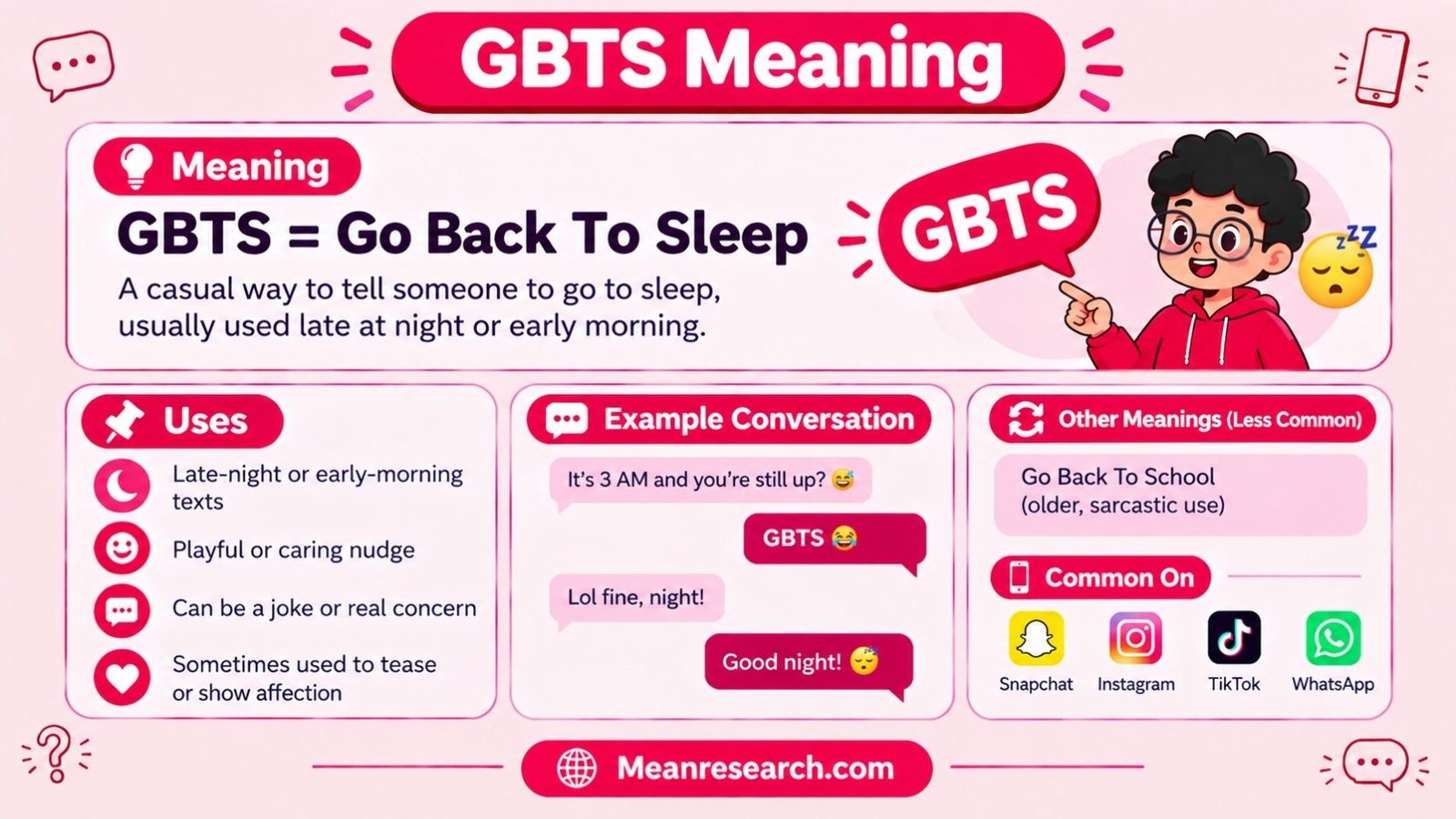
If someone just texted you “GBTS” and you’re staring at your phone trying to decode it, the short answer is this: GBTS almost always means “Go Back To Sleep” (sometimes written as “Going Back To Sleep”). It’s a casual, friendly bit of texting shorthand, usually sent late at night or first thing in the morning, and it’s meant to be lighthearted rather than serious.
That’s the meaning with real staying power and documented use. But because GBTS isn’t an official dictionary word, you’ll also see other claimed meanings floating around online. Below, we’ll walk through what’s actually verifiable, what’s just internet guesswork, and how to read the acronym correctly no matter where you spot it.
Quick Definition Box
| Full form | Go Back To Sleep (also written “Going Back To Sleep”) |
| Type | Internet and texting slang, not a dictionary term |
| Tone | Playful, caring, occasionally sarcastic |
| Where it’s used | Text messages, Instagram, Snapchat, TikTok comments, group chats |
| Formal setting? | No avoid it in work or professional messages |
| First documented use | Urban Dictionary, 2010 |
The Main Meaning: Go Back To Sleep
The core, well-documented use of GBTS is exactly what it looks like once you sound it out: Go Back To Sleep. People use it in a few overlapping situations, and knowing which one applies just takes a quick look at the context around it.
Someone is texting way too early or way too late. If a friend messages you at 3 a.m. rambling about something random, or texts you at 6 a.m. before their alarm should have gone off, replying “GBTS” is a quick, friendly way of saying “you should still be asleep, go handle that.” It doesn’t need explaining further; the timestamp alone usually makes the joke land.
Someone says something that doesn’t quite make sense. GBTS also gets used the way people might say “are you dreaming?” or “wake up” as a teasing response when someone says something dramatic, exaggerated, or a little out of touch with reality. It’s the texting equivalent of a raised eyebrow rather than an actual accusation that the person is asleep.
Someone is clearly exhausted. Sometimes it’s used with real care rather than teasing a way of telling a tired friend or partner to stop typing and get some rest. The emoji attached (😴 versus 😂, for example) usually signals which version is meant.
Read More: ISG Meaning In Text
Verified Example
“N: I heard school is off because of the snow. H: GBTS. N: Same here.”
This example comes from an Urban Dictionary submission and shows the acronym used almost exactly as spelled out; one person signals they’re heading back to bed, and the conversation moves on.
Where GBTS Shows Up
GBTS isn’t tied to one single app. It travels across whichever platform two people happen to be chatting on, and the underlying meaning doesn’t really change only the pace and tone of the conversation does.
- Text messages (SMS/iMessage): The most traditional home for GBTS, usually in one-on-one chats between friends or family.
- Instagram DMs and comments: Common as a quick, casual reply, especially in late-night direct messages.
- Snapchat: Fits naturally alongside other short slang because Snapchat conversations tend to be quick and informal by design.
- TikTok comments: Used the same playful way, often as a reaction to a video posted at an odd hour or one that feels a little “out there.”
- Group chats: Works as a quick, funny reply that doesn’t derail the conversation.
GBTS Meaning In Text From A Girl
There’s nothing about GBTS that changes meaning based on who sends it. When it comes from a girl, a guy, a friend, or a sibling, it’s still functioning as slang for “go back to sleep,” used in a caring, joking, or occasionally sarcastic way depending on the conversation.
Some content sites claim GBTS carries a flirty or “affectionate” meaning specifically when a girl sends it; that framing doesn’t line up with any documented usage record, so treat it as speculation rather than an established alternate meaning. Read it the same way you would from anyone: check the time it was sent and what was said right before it, and the intended tone becomes obvious.
Read More: Stay Tuned Meaning
Other Claimed Meanings (And Why To Be Careful With Them)
Search around and you’ll find a handful of other supposed expansions for GBTS “Gotta Be The Same,” “Gonna Be There Soon,” “Great Big Time Soon.” Here’s the honest picture on those.
Note: These alternate meanings appear almost exclusively on recently published slang blogs with no cited real-world examples, no dated forum or Urban Dictionary entries backing them up, and often contradictory definitions of the same acronym from one site to the next.
That pattern is a strong sign the definitions were invented or AI-generated rather than pulled from how people actually text. If you come across GBTS used in a way that clearly isn’t about sleep, it’s more likely a private inside joke specific to that friend group than an established alternate meaning.
There is one older, separate slang use worth knowing about, because it’s the one other GBTS entry with an actual paper trail: “Go Back To School” (or “Get Back To School”), recorded on Urban Dictionary back in 2012.
It’s used sarcastically, as a comeback when someone says something obviously false or ridiculous similar in spirit to “go read a book.” It’s much less common today than the “sleep” meaning, but if GBTS shows up as a sharp, dismissive reply to a wrong statement rather than a comment on the time of night, this older use is the likely fit.
Comparison Table: The Two Documented Meanings
| Meaning | Full Form | Typical Tone | When You’ll See It |
| Most common | Go Back To Sleep | Playful, caring, or mildly teasing | Late-night or early-morning texts |
| Less common, older | Go/Get Back To School | Sarcastic, dismissive | Response to a silly or false claim |
How To Reply To GBTS
There’s no wrong way to respond, since GBTS is casual by nature, but a few replies fit the tone naturally.
- Play along: “Lol fine, night” or “Okay okay, going” keeps the joke going if it was sent playfully.
- Push back lightly: “No I’m up now lol” works if you’re actually awake and want to keep chatting.
- Say thanks if it was caring: A simple “aw thanks, night” fits if a friend was genuinely telling you to rest.
Is GBTS Rude?
On its own, no. GBTS is built to be lighthearted, and in most conversations it reads as friendly teasing rather than an insult. The tone can shift toward dismissive only if it’s used repeatedly to brush off something someone said seriously, or sent with a flat tone and no emoji in a conversation that was already tense. As with most texting slang, the words matter less than the relationship and the moment they were sent in.
Where GBTS Doesn’t Belong?
Keep GBTS out of work emails, messages to teachers or professors, customer service chats, or any conversation where you’re expected to sound professional. It’s built for casual, low-stakes messaging between people who already know each other, and it can come across as unclear or unprofessional outside that context.
GBTS vs. Similar Texting Acronyms
| Acronym | Meaning | Typical Use |
| GBTS | Go Back To Sleep | Late-night/early-morning teasing or care |
| BRB | Be Right Back | Stepping away briefly during a chat |
| GN or GN8 | Good Night | Ending a conversation for the night |
| IMY | I Miss You | Expressing you miss someone |
| WYD | What (Are) You Doing | Casual check-in |
Read More: Well Noted Meaning
Quick Tip About GBTS
If GBTS shows up and the meaning isn’t obvious, look at two things: the time the message was sent, and what was said right before it. Nine times out of ten, that context alone tells you whether it means “go back to sleep” or something specific to that particular friend group.
Frequently Asked Questions
What does GBTS mean in text?
GBTS most commonly means “Go Back To Sleep,” used casually between friends or family, often late at night or early in the morning.
What does GBTS mean in text from a girl?
The same as from anyone else “Go Back To Sleep.” The sender’s gender doesn’t change the meaning.
What does GBTS mean on Instagram?
It’s used the same way in Instagram DMs and comments as in regular texting: a casual, playful nudge about sleep or tiredness.
What does GBTS mean on Snapchat?
Same core meaning “Go Back To Sleep” fitting naturally into Snapchat’s fast, informal chat style.
What does GBTS mean on TikTok?
Commonly used in comments the same way, often as a playful reaction to something posted at an odd hour or that sounds tired or exaggerated.
Is GBTS rude?
Not inherently. It’s meant as lighthearted slang, though tone and relationship context can shift how it lands.
What is the origin of GBTS?
It grew out of general texting culture as a shortcut for “go back to sleep,” with the earliest documented Urban Dictionary entry dating to 2010. There’s no single confirmed “first use.”
Does GBTS ever mean something other than “sleep”?
An older, less common slang use from 2012 stands for “Go Back To School,” used sarcastically toward a false or silly claim. Other claimed meanings circulating online lack real documentation.
Is GBTS OK to use at work?
No. It’s informal slang and doesn’t fit professional messages, emails, or workplace chats.
How should I reply to GBTS?
Match the tone it was sent in play along if it’s a joke, clarify if you’re actually awake, or say thanks if it was meant caringly.
The Bottom Line
GBTS is a small piece of everyday texting slang with one meaning that’s actually well documented: “Go Back To Sleep,” usually sent as a playful or caring nudge during late-night or early-morning conversations.
If you see other claimed meanings online, treat them with some skepticism; they don’t have the same track record, and slang like this often means whatever a specific friend group has decided it means. When in doubt, the timestamp and the conversation around it will tell you everything you need to know.

Hooriya Salman is the writer and researcher behind Mean Research, with 4 years of experience researching and writing about word meanings, slang, names, and everyday language. Their aim is to provide clear, accurate, and easy-to-understand explanations that help readers discover the meaning behind unfamiliar words, expressions and names.
3 Comments