
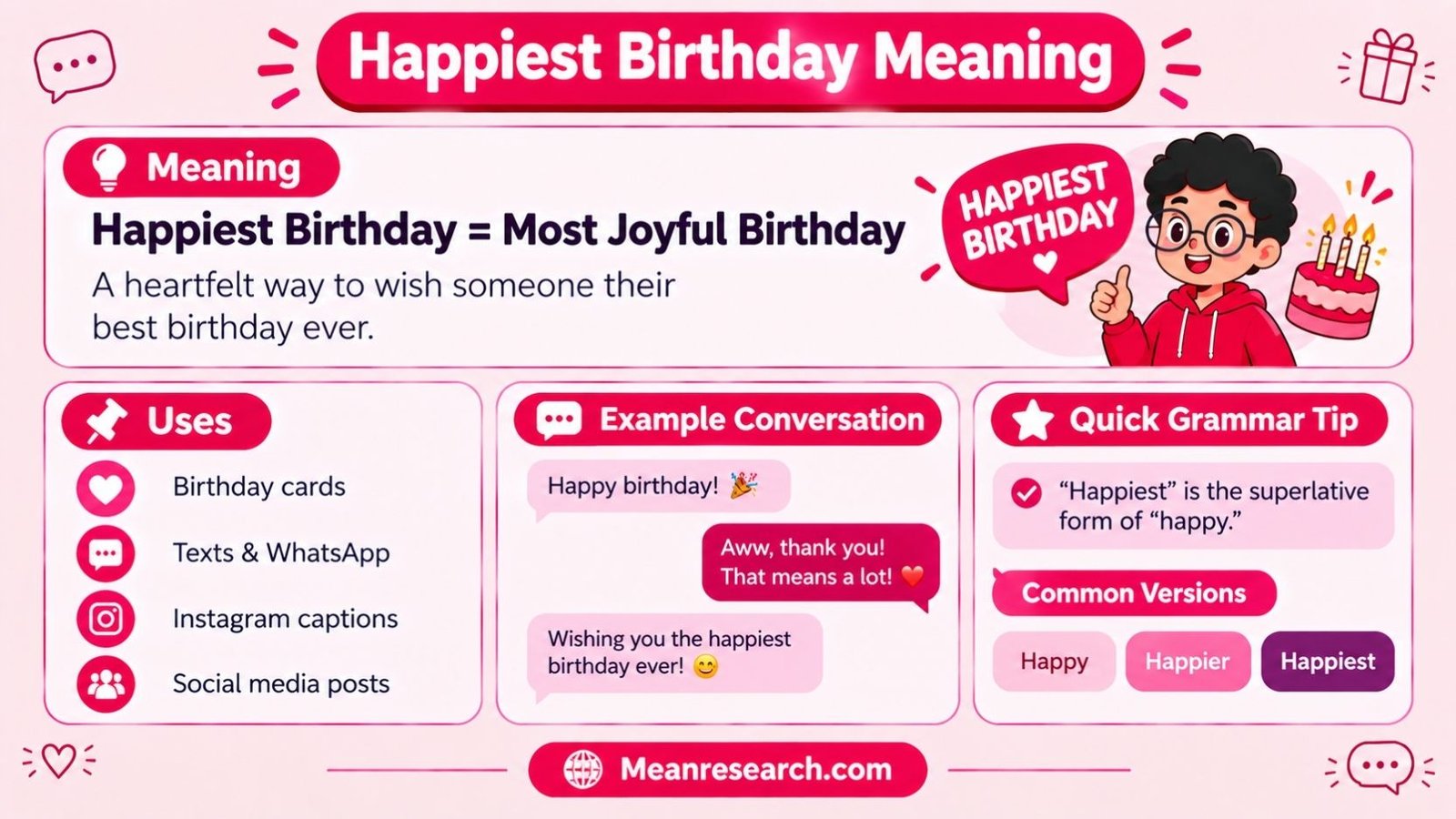
“Happiest birthday” means wishing someone the most joyful birthday they have ever had, using the superlative form of “happy” to add extra warmth to a greeting. It is an emotional upgrade of the standard “Happy Birthday,” and while grammar purists debate its correctness, native speakers use it every day on cards, texts, and social media to express bigger, more heartfelt joy.
If you have ever typed “happiest birthday” into a birthday card and then paused, wondering if it actually makes sense, you are not alone. This phrase shows up constantly in birthday wishes, WhatsApp messages, and Instagram captions, yet very few explanations actually break down where it comes from, why it sounds a little unusual to some ears, and how it is understood across different languages and cultures.
This guide answers all of that in one place, using verified grammar sources, dictionary definitions, and real usage patterns, so you can use the phrase with total confidence.
What Does “Happiest Birthday” Mean?
At its core, “happiest birthday” is built from the word “happy,” an adjective that Merriam-Webster defines as enjoying or being characterized by well-being and contentment. When you add “-est” to an adjective, you create its superlative form, the version used to describe the highest possible degree of that quality within a group. So “happiest” technically means “the most happy,” placing this specific birthday above every other birthday that person has ever had.
In everyday use, though, nobody is running a scientific comparison of past birthdays. People say “happiest birthday” the same way they say “biggest congratulations” or “warmest wishes,” as an intensifier rather than a literal ranking. The phrase works emotionally even when it bends slightly from strict grammar, because greetings are about feeling, not precision.
That is really the heart of the “happiest birthday meaning”: it is a wish for someone’s best, most joy filled birthday yet. It carries more emotional weight than a plain “Happy Birthday,” which is why so many people reach for it when writing a message to someone they care about deeply.
Quick definition: Happiest birthday means “the most joyful birthday,” using the superlative of “happy” to intensify a birthday greeting beyond the standard phrase.
Read More: GBTS Meaning In Text
Is “Happiest Birthday” Grammatically Correct?
This is the question almost everyone searching this topic actually wants answered, so let’s settle it clearly. Grammar guides consistently point out that “happiest” is a superlative adjective, and standard English grammar usually pairs superlative adjectives with the definite article “the,” as in “the happiest,” “the tallest,” or “the smartest.” Said on its own, without “the,” the phrase stretches typical grammar rules, even though most native speakers immediately understand what it means.
The cleanest, most textbook-correct versions of the phrase include an article or a comparison word. Grammar resources point to constructions like “wishing you the happiest of birthdays” or “have the happiest birthday yet” as fully correct, because the word “of” or “yet” gives the superlative something to compare against.
Without that extra structure, “happiest birthday” functions more like a fixed, informal expression than a textbook sentence, similar to how “Happy Birthday” itself is treated as a set greeting rather than a strict grammatical construction.
The Superlative Rule Explained
English adjectives generally move through three degrees: the positive form (happy), the comparative form (happier), and the superlative form (happiest). The superlative is reserved for comparing three or more things and usually needs “the” in front of it, similar to saying “she is the smartest in the class” rather than just “she is smartest.”
Birthday greetings, however, are considered fixed expressions, phrases that function as a single emotional unit rather than a sentence built word by word. This is exactly why “Happy Birthday” itself skips normal grammar too, since nobody says “a happy birthday to you” in casual speech. Because greetings often break standard sentence patterns for the sake of rhythm and warmth, “happiest birthday” survives as an accepted variation even without the article.
Happy vs Happier vs Happiest
Seeing the three forms side by side makes the logic click immediately, and it also explains why some people search for “happy happier happiest birthday meaning” when they come across playful versions of the phrase online. Each step up intensifies the wish a little more, moving from a simple greeting to a warm comparison to a full emotional peak.
- Happy – the base greeting, universally understood and grammatically simple, used in “Happy Birthday.”
- Happier – the comparative form, implying “more happy than before,” often used in phrases like “may this year be happier than the last.”
- Happiest – the superlative form, implying “the most happy,” used in “happiest birthday” to signal maximum joy.
Note: Some birthday cards and social posts deliberately write “happy, happier, happiest birthday” as a stylistic escalation. This is a creative device, not a grammar rule, and it works precisely because readers already understand the three degrees of the adjective.
Where the Phrase “Happy Birthday” Comes From
Understanding the origin of “Happy Birthday” itself helps explain why superlative versions like “happiest birthday” feel so natural to add on top of it. The phrase and its melody trace back to 1893, when American sisters Patty Smith Hill, a kindergarten teacher in Louisville, Kentucky, and Mildred Jane Hill, a pianist, published a children’s song called “Good Morning to All” for classroom use. The tune was simple enough for young children to sing with ease, which is part of why it spread so widely once new lyrics were attached to it.
New birthday themed lyrics set to that same melody first appeared in print in the early twentieth century, and by 1924 an alternate birthday verse was published in a songbook edited by Robert H. Coleman. From there, “Happy Birthday to You” spread through radio, film, and Broadway, eventually becoming, according to Guinness World Records, the most recognized song in the English language. That widespread, deeply familiar base phrase is exactly why so many playful variations, including “happiest birthday,” “happy happier happiest birthday,” and “the happiest of birthdays,” have grown up around it over the decades.
Quick Fact: “Happy Birthday to You” has been translated into at least eighteen languages, and its underlying tune, originally written for a completely different children’s song, is now one of the most widely sung melodies on the planet.
Happy Birthday vs Happiest Birthday vs Happiest of Birthdays
Since so many searches compare these phrases directly, a side by side table makes the differences easiest to absorb at a glance.
| Phrase | Grammatical Structure | Tone | Best Used For |
| Happy Birthday | Fixed greeting, adjective plus noun | Standard, universal | Any birthday, formal or informal |
| Happiest Birthday | Superlative without article, informal fixed phrase | Warm, enthusiastic, slightly informal | Close friends, family, social media |
| Happiest of Birthdays | Superlative with “of” for grammatical support | Poetic, textbook correct, still warm | Cards, heartfelt messages, formal notes |
| The Happiest Birthday | Superlative with definite article | Grammatically standard | Written messages, speeches, formal cards |
| Have the Happiest Birthday Yet | Superlative with comparison word “yet” | Fully correct, emotionally rich | Milestone birthdays, close relationships |
How to Use “Happiest Birthday” Correctly
Knowing the grammar is one thing, but knowing how to actually place the phrase in a sentence is what most people are really after. The good news is that a few small additions instantly make the phrase sound more polished without losing its warmth.
- Wishing you the happiest of birthdays today and always.
- Have the happiest birthday ever, filled with love and laughter.
- I hope this is your happiest birthday yet.
- Sending you the happiest birthday wishes, my friend.
- May your day be the happiest one yet, full of joy and celebration.
Quick Tip: If you want the phrase to sound effortlessly correct in writing, add “the,” “of,” “yet,” or “ever” right after or around “happiest.” These small words do the grammatical work that turns an informal exclamation into a properly structured sentence.
Capitalization: “Happy Birthday” or “happy birthday”?
Capitalization confuses a lot of people, and it applies equally to “happiest birthday.” As a general rule, capitalize “Happy Birthday” when it functions as a direct greeting on its own, such as on a card, a banner, or the first words of a message, similar to how “Good Morning” or “Merry Christmas” are capitalized as standalone greetings. When the same words appear inside a regular sentence, lowercase is standard, as in “I called to wish her a happy birthday” or “he sent the happiest birthday message I have ever read.”
The same logic carries over cleanly to “happiest birthday”: capitalize it when it opens a card or stands alone as the greeting itself, and lowercase it when it is folded into a longer sentence. Neither choice is a hard legal rule the way spelling is, but following this pattern keeps your writing consistent with how professional style guides and greeting card companies format similar phrases.
“Wish You Happiest Birthday” Meaning
“Wish you happiest birthday” is a shortened, conversational version of “I wish you the happiest birthday,” and it appears constantly in text messages, WhatsApp greetings, and social media comments, especially among speakers who learned English as a second language.
The meaning stays exactly the same as the fuller phrase: the sender is hoping this birthday brings the recipient more joy than any birthday before it. Dropping the subject “I” and the article “the” is common in casual, fast typed digital communication, where speed and warmth matter more than textbook grammar.
This shortened pattern is especially common in India, Pakistan, Bangladesh, and other regions where English operates alongside local languages, because many of those languages naturally drop articles and pronouns that English grammar requires.
So when you see “wish you happiest birthday” on a friend’s Instagram post, it is not a mistake so much as a blend of local speech patterns layered onto English vocabulary. Understood in context, the sentiment comes through perfectly clearly, even if a strict grammar teacher might mark it up with a red pen.
“Have a Happiest Birthday” Meaning
“Have a happiest birthday” combines the indefinite article “a” with a superlative adjective, which is where things get grammatically tangled, since superlatives are supposed to compare something specific, not describe one option among many.
Despite the mismatch, the intended meaning is completely clear: the sender wants this particular birthday to be the best, happiest one the recipient has ever experienced. It is one of the most common “almost right” versions of the phrase, and it shows up on greeting cards, cake toppers, and party banners worldwide.
If you want a version that keeps the same energy but reads more smoothly, “have the happiest birthday” or “have a wonderful, happiest birthday yet” both fix the small grammatical friction while keeping every ounce of the original warmth.
“The Happiest Birthday” Meaning
“The happiest birthday” is actually the most grammatically solid version of this entire phrase family, because it follows the standard rule that superlative adjectives take the definite article “the.” This version tells someone directly that you hope their current birthday outranks every birthday they have had before, framed as a clear, singular comparison rather than a vague exclamation.
Because it is the version grammar guides consistently point to as correct, “the happiest birthday” works especially well in formal writing, speeches, wedding or milestone birthday toasts, and printed cards where you want the wording to hold up under closer reading.
Happiest Birthday Meaning From A Girl
When someone searches “happiest birthday meaning from a girl,” they are usually asking one of two things: either what it means when a girl sends this specific message, or whether the phrase carries any hidden romantic undertone. In plain terms, the words themselves do not change meaning based on who sends them. “Happiest birthday” from a girl, a boy, a parent, or a coworker means exactly the same thing: a wish for maximum happiness on someone’s birthday.
Any romantic or deeper meaning comes entirely from context, not from the phrase itself. A message that says only “happiest birthday” from a casual acquaintance is simply a warm, friendly greeting, while the same words paired with personal details, inside jokes, heart emojis, or a longer heartfelt message can signal closeness or affection. The grammar and vocabulary stay constant; it is tone, length, and surrounding context that reveal whether a message is casual, friendly, or something more.
Note: If you are trying to interpret a specific message from someone, look at the full conversation and relationship history rather than reading meaning into three words alone. Language carries intent through context, not through isolated superlatives.
“Happiest Belated Birthday” Meaning
“Happiest belated birthday” combines two ideas at once: the superlative warmth of “happiest” and the apology built into “belated,” which simply means “arriving after the expected time.” Together, the phrase means something like “I know this wish is coming late, but I still hope your birthday was the most joyful one yet.” It is a natural way to acknowledge that you missed the actual date while still delivering the same intensity of good wishes you would have sent on time.
Grammatically, this phrase works a little more smoothly than the bare “happiest birthday,” since “belated” already modifies “birthday” as a full descriptive phrase, softening the need for an article. Common natural sounding versions include “happiest belated birthday to you” or “wishing you a very happy, though belated, birthday,” both of which read comfortably in casual messages, cards, and social media comments sent a few days after the actual celebration.
“Happiest First Birthday” Meaning
“Happiest first birthday” is a phrase parents, grandparents, and family friends use specifically for a baby’s very first birthday, a milestone widely treated as extra special because it marks a full year of growth and new experiences.
The word “first” here does real grammatical work, giving the superlative “happiest” a clear point of comparison: this is being singled out among a lifetime of future birthdays as an especially meaningful one to celebrate. That structure is actually closer to standard grammar than the bare “happiest birthday,” since “first” supplies the missing comparison that superlatives normally require.
You will see this phrase constantly on first birthday cards, cake toppers, and social media captions marking a baby’s milestone, often paired with wishes for good health, happiness, and everything that comes with a child’s first year of life.
Regional And Cultural Usage: United States, United Kingdom And India
Where you are, and who you are talking to, genuinely changes how natural “happiest birthday” sounds, and understanding these regional patterns helps explain why the phrase feels so different depending on where you encounter it.
| Region | Common Usage | Formality Level | Notes |
| United States | Frequently used in casual writing, cards, and social media | Informal to semi-formal | Full phrases like “have the happiest birthday ever” are preferred over the bare phrase |
| United Kingdom | Less common; “Happy Birthday” remains the default | Formal preference | Superlative versions are understood but read as slightly unusual or overly enthusiastic |
| India, Pakistan, Bangladesh, Nepal | Increasingly popular, especially among younger, social media active users | Casual and widely accepted | English operates alongside many local languages, so shortened or article free phrasing is common |
In the United States, “happiest birthday” and its variations show up constantly on cards, Instagram captions, and text messages, largely because American English embraces expressive, emotionally amplified language in casual settings. British English, by contrast, tends to favor the simpler, time tested “Happy Birthday,” treating superlative versions as a bit theatrical for everyday use.
Across South Asia, the phrase has become genuinely popular in English language birthday wishes, partly because local languages already use their own versions of intensified, joy focused greetings, and partly because English is often a second or third language layered on top of different grammatical instincts.
Happiest Birthday Meaning In Different Indian Languages
Because so many people search for this phrase specifically in Hindi, Tamil, Urdu, Gujarati, Bengali, Marathi, Kannada, Malayalam, Telugu, and Nepali, it helps to understand something important upfront: most Indian languages do not have a single word that works exactly like the English superlative “happiest.” Instead, birthday greetings in these languages typically combine a word for “birthday” with a word for “blessings,” “good wishes,” or “congratulations,” and warmth is added through tone, extra words, or repetition rather than through a grammatical superlative form.
That means when someone asks for the “happiest birthday meaning in Hindi” or a similar language, what they usually want is the standard, warmly worded birthday greeting in that language, since a literal word for word superlative translation does not carry the same natural meaning it does in English. Below is a breakdown of how each language expresses birthday joy, based on standard, verified greeting phrases used by native speakers.
It also helps to remember that India, Pakistan, Bangladesh, and Nepal are home to dozens of major languages and countless regional dialects, so any single greeting listed here represents the most common, widely recognized version rather than the only version that exists. Families often mix English words directly into their greetings too, which is exactly why phrases like “happiest birthday” and “wish you happiest birthday” have become so common even in conversations that otherwise happen entirely in Hindi, Urdu, Tamil, or another regional language.
Happiest Birthday Meaning In Hindi
In Hindi, the standard birthday greeting is “जन्मदिन मुबारक हो” (Janamdin Mubarak Ho), which translates literally to “may your birthday be blessed” or simply “happy birthday.”
There is no single Hindi word that functions as a direct superlative of “happy” the way “happiest” does in English, so extra warmth is usually added with words like “बहुत बहुत” (bahut bahut, meaning “very very”) placed before the greeting, producing phrases like “जन्मदिन की बहुत बहुत शुभकामनाएं” (janamdin ki bahut bahut shubhkamnayein), meaning “very many good wishes on your birthday.”
So when someone searches “happiest birthday meaning in Hindi,” the honest, accurate answer is that Hindi expresses that same heightened joy through intensifying words and repetition rather than a single superlative adjective, and the closest natural equivalent is a warmly worded, repeated blessing rather than a literal one word translation.
Happiest Birthday Meaning In Urdu
The standard Urdu birthday greeting is “سالگرہ مبارک” (Saalgirah Mubarak), where “saalgirah” literally means “year knot,” referring to the completion of another year, and “mubarak” means “blessed” or “congratulations.” As in Hindi, Urdu does not have a direct single word superlative for “happiest,” so speakers intensify the greeting with additional phrases rather than a grammatical superlative form.
A warmer, more elaborate version might read “آپ کو سالگرہ بہت بہت مبارک ہو” (Aap ko saalgirah bohot bohot mubarak ho), which adds “bohot bohot” (very very) to intensify the blessing, producing the emotional equivalent of “happiest birthday” even though the literal grammar works differently than English superlatives.
Happiest Birthday Meaning In Tamil
In Tamil, the common birthday greeting is “பிறந்தநாள் வாழ்த்துக்கள்” (Piranda Naal Vaazhthukkal), which translates to “birthday greetings” or “birthday wishes.” Tamil greetings typically add warmth through additional blessing words rather than a single superlative adjective, so a fuller, more heartfelt version often includes wishes for long life and happiness layered around the core phrase.
Happiest Birthday Meaning In Telugu
Telugu speakers commonly say “పుట్టినరోజు శుభాకాంక్షలు” (Puttinaroju Shubhakankshalu), meaning “birthday good wishes.” As with the other Dravidian and Indo Aryan languages listed here, the emotional intensity of “happiest” is usually expressed through extra descriptive words layered onto the base greeting rather than a single superlative form.
Happiest Birthday Meaning In Kannada
In Kannada, the standard greeting is “ಹುಟ್ಟುಹಬ್ಬದ ಶುಭಾಶಯಗಳು” (Huttuhabbada Shubhashayagalu), which means “birthday good wishes” or “birthday congratulations.” The structure again favors compound blessing phrases over single word superlatives, meaning the “happiest” feeling comes through in tone and additional wishes rather than in one specific word.
Happiest Birthday Meaning In Malayalam
Malayalam speakers typically say “പിറന്നാൾ ആശംസകൾ” (Pirannal Aashamsakal) or “ജന്മദിനാശംസകൾ” (Janmadinaashamsakal), both meaning “birthday wishes.” Once again, the concept of “happiest” is layered in through additional words expressing joy, health, and long life rather than through a direct grammatical superlative.
Happiest Birthday Meaning In Marathi
In Marathi, the common greeting is “वाढदिवसाच्या हार्दिक शुभेच्छा” (Vadhdivasachya Hardik Shubhechha), which translates to “heartfelt birthday wishes.” The word “हार्दिक” (hardik, meaning “heartfelt” or “hearty”) already functions as an intensifier, doing similar emotional work to the English “happiest,” even though it is not a grammatical superlative.
Happiest Birthday Meaning In Gujarati
Gujarati speakers commonly say “જન્મદિવસની શુભકામનાઓ” (Janmadivasni Shubhkamnao), meaning “birthday good wishes,” with some speakers also using “જન્મ દિવસ ના અભિનંદન” (Janamdivas na Abhinandan), meaning “congratulations on your birthday.” As with the related North Indian languages, intensity and warmth are added through extra words rather than a single superlative form.
Read More: What Does WYF Mean On Snapchat?
Happiest Birthday Meaning In Bengali
In Bengali, the standard greeting is “শুভ জন্মদিন” (Shubho Jonmodin), meaning “auspicious birthday” or “happy birthday.” The word “শুভ” (shubho) carries a sense of auspiciousness and blessing, and warmth beyond the base greeting is typically added through longer, more descriptive wishes rather than a direct superlative equivalent.
Happiest Birthday Meaning In Nepali
Nepali birthday greetings generally follow a similar pattern to neighboring Hindi and Indian language greetings, combining a word for birthday with a word for congratulations or good wishes, and adding warmth through extra descriptive phrases rather than a single superlative word.
As with the other languages above, there is no single Nepali word that functions as a precise equivalent of “happiest,” so the emotional intensity of the phrase comes through in tone, context, and additional blessings layered around the core greeting.
Quick Reference Table: Standard Birthday Greetings by Language
| Language | Common Greeting | Transliteration | Literal Meaning |
| Hindi | जन्मदिन मुबारक हो | Janamdin Mubarak Ho | May your birthday be blessed |
| Urdu | سالگرہ مبارک | Saalgirah Mubarak | Blessed year knot (birthday) |
| Tamil | பிறந்தநாள் வாழ்த்துக்கள் | Piranda Naal Vaazhthukkal | Birthday greetings |
| Telugu | పుట్టినరోజు శుభాకాంక్షలు | Puttinaroju Shubhakankshalu | Birthday good wishes |
| Kannada | ಹುಟ್ಟುಹಬ್ಬದ ಶುಭಾಶಯಗಳು | Huttuhabbada Shubhashayagalu | Birthday good wishes |
| Malayalam | പിറന്നാൾ ആശംസകൾ | Pirannal Aashamsakal | Birthday wishes |
| Marathi | वाढदिवसाच्या हार्दिक शुभेच्छा | Vadhdivasachya Hardik Shubhechha | Heartfelt birthday wishes |
| Gujarati | જન્મદિવસની શુભકામનાઓ | Janmadivasni Shubhkamnao | Birthday good wishes |
| Bengali | শুভ জন্মদিন | Shubho Jonmodin | Auspicious birthday |
Note: These are standard, widely used greetings sourced from established language reference material. Regional dialects, religious backgrounds, and family traditions can all shape the exact phrasing people actually use, so treat these as reliable starting points rather than the only correct version.
Example Messages By Relationship
The right version of “happiest birthday” often depends on who you are writing to, since the same core words can be dressed up or simplified depending on the relationship and the occasion. Below are example messages organized by relationship, all built around the phrase, so you can see how it flexes across different tones.
- For a close friend: Happiest birthday, you absolute legend. Here’s to another year of chaos, laughter, and everything that makes you, you.
- For a parent: Wishing you the happiest birthday, Mom. Thank you for every single thing you have done for our family over the years.
- For a partner or spouse: Happy, happier, happiest birthday to the person who makes every single day better just by being in it.
- For a coworker or boss: Wishing you the happiest of birthdays and a well-deserved day of celebration. Enjoy every moment.
- For a sibling: Happiest birthday, little bro. I still remember when you couldn’t even blow out your own candles, and look at you now.
- For a child’s birthday card: Have the happiest birthday ever, filled with cake, presents, and every bit of fun a birthday should have.
- For a grandparent: Wishing you the happiest birthday and another year filled with the same warmth and love you have always given us.
Note: Notice how each example pairs “happiest birthday” with a specific, personal detail rather than leaving the phrase to stand entirely on its own. That combination of a warm superlative plus a genuine personal touch is what actually makes a birthday message memorable, far more than the specific grammar choice does.
Synonyms And Similar Expressions
If “happiest birthday” starts to feel repetitive across multiple cards or messages, several synonyms and near equivalents carry the same intensified warmth without repeating the exact same words.
| Expression | Feel | Best Context |
| Warmest birthday wishes | Gentle, sincere | Formal cards, coworkers, acquaintances |
| Many happy returns | Traditional, slightly formal | Classic greeting cards, older generations |
| Blessed birthday | Warm, often faith-based | Family, religious communities |
| Best birthday ever | Casual, enthusiastic | Close friends, younger audiences |
| Joyous birthday | Elevated, poetic | Formal writing, speeches |
| Cheers to another amazing year | Playful, celebratory | Social media captions, party settings |
Better Alternatives to “Happiest Birthday”
If you like the warmth of “happiest birthday” but want a version that reads as fully correct in formal writing, several alternatives capture the same energy while following standard grammar rules more closely.
- Wishing you the happiest of birthdays.
- May this be your happiest birthday yet.
- Have the happiest birthday ever.
- Sending you the warmest, happiest birthday wishes.
- Hope your birthday is filled with the happiest moments.
- Wishing you a birthday as wonderful as you are.
- May your day be as joyful and bright as you deserve.
Warning: Avoid stacking multiple superlatives together in one sentence, such as “have the best, happiest, most amazing birthday ever,” since this quickly starts to sound exaggerated rather than sincere. One well placed superlative, supported by a genuine, specific detail about the person, almost always lands better than a pile of intensified adjectives.
Pronunciation Guide
Getting the pronunciation right matters, especially if you plan to say the phrase out loud during a toast, a video message, or a phone call. “Happiest” is pronounced HAP-ee-ist, with three syllables and the stress falling clearly on the first syllable, the same stress pattern as the base word “happy.” The word “birthday” follows immediately after with its own natural stress on the first syllable, BURTH-day, giving the full phrase a steady, front loaded rhythm: HAP-ee-ist BURTH-day.
When speaking the fuller, more grammatically complete versions, the rhythm stays smooth as long as you let the small connecting words flow naturally rather than pausing awkwardly before them. “Wishing you the happiest of birthdays” reads comfortably as one continuous phrase, with slight emphasis on “happiest” itself, since that word is carrying the emotional weight of the whole sentence.
How Dictionaries Define “Happy” and “Happiest”
Going back to the dictionary definition helps ground the entire discussion in something concrete rather than opinion. Merriam-Webster defines “happy” as enjoying or characterized by well-being and contentment, and separately as feeling or showing pleasure. As the superlative form of that same adjective, “happiest” describes the highest possible degree of that well-being and contentment, meaning the greatest level of enjoyment or pleasure a person can experience.
That dictionary grounding matters because it confirms “happiest birthday” is not some invented internet phrase with no real linguistic basis. It is a completely standard English adjective, used in its completely standard superlative form, simply applied to a greeting in a way that occasionally skips the article that formal grammar expects. Understanding this distinction is genuinely useful: the vocabulary itself is entirely correct, and any debate about “correctness” is really a debate about sentence structure, not about whether “happiest” is a real or proper word.
When to Use It and When to Skip It
Not every situation calls for the same level of enthusiasm, and knowing when to reach for “happiest birthday” versus a simpler greeting can save you from a message that feels mismatched to the moment.
- Use it for: close friends, family members, romantic partners, milestone birthdays, and any message where you want extra warmth to come through clearly.
- Use it for: social media captions, greeting cards, and messages where a slightly more expressive tone fits the platform.
- Consider a simpler option for: highly formal business correspondence, official company announcements, or messages to someone you do not know well, where “Happy Birthday” or “warmest birthday wishes” may read as more appropriately professional.
- Consider a simpler option for: condolence adjacent birthdays, such as a first birthday after losing a loved one, where a gentler, quieter tone often fits the moment better than maximum enthusiasm.
Warning: Context always outranks vocabulary. Even the warmest, most grammatically perfect version of “happiest birthday” can feel tone deaf if the timing or relationship does not call for that level of enthusiasm, so read the room before you reach for the superlative.
Common Mistakes to Avoid
A few small habits separate a polished birthday message from one that feels rushed or slightly off, and knowing them helps you write with more confidence every time.
- Using “a” before “happiest” without a supporting comparison word, as in “have a happiest birthday,” which grammar guides flag as one of the more awkward constructions.
- Relying only on “happiest birthday” without any surrounding detail, which can feel generic even though the words themselves are warm.
- Overusing superlatives in a single message, which dilutes their impact rather than strengthening it.
- Assuming a literal, word for word translation exists in every language, when many languages express the same warmth through intensifying phrases instead of a single superlative word.
- Forgetting that context, tone, and relationship history shape how a phrase is received far more than the specific wording chosen.
Read More: ISG Meaning In Text
Why Superlatives Feel More Personal in Greetings
There is a simple reason superlative phrases like “happiest birthday” have spread so widely across texts, cards, and social captions: they signal effort. Choosing “happiest” instead of the default “happy” tells the recipient that you thought about the wording for even half a second longer than the bare minimum, and that small signal of extra care often lands more warmly than the words themselves technically justify. Language researchers who study everyday speech note that intensifiers, words that boost the strength of an adjective, are one of the most common ways people add emotional color to otherwise routine, repeated phrases.
Birthdays are repeated every single year, which means the greetings attached to them face constant risk of feeling routine or automatic. Reaching for “happiest,” “warmest,” or “biggest” instead of the plain, default adjective is a small linguistic trick for pushing back against that repetition, making a yearly ritual feel freshly sincere rather than copy pasted. This is likely why superlative birthday phrases have grown especially popular on social media, where messages are short, public, and competing for attention among dozens of similar posts on the same day.
None of this means the bare “Happy Birthday” is somehow lesser or insincere; it remains the single most universally understood and appropriate birthday greeting in the English language. But understanding why “happiest birthday” resonates so strongly with so many people explains its popularity far better than grammar rules alone ever could, and it is worth keeping in mind the next time you are deciding which version fits the birthday message you are about to send.
Frequently Asked Questions
Is “happiest birthday” grammatically correct?
Not on its own by strict grammar rules, since superlatives usually need “the” or a comparison word. Versions like “the happiest birthday” or “happiest of birthdays” are fully correct.
What does “wish you happiest birthday” mean?
It means “I wish you the happiest birthday,” a shortened, casual way of hoping someone has their most joyful birthday yet.
Can I say “happiest birthday” to a boss or colleague?
Yes, though “the happiest birthday” or “warmest birthday wishes” sound slightly more polished for professional settings.
Is “happiest birthday” the same as “happy birthday”?
They share the same core meaning but “happiest birthday” adds extra emotional intensity through the superlative form of “happy.”
Why do people in India use “happiest birthday” so often?
English blends with local language patterns that naturally intensify greetings through extra words, and social media has popularized the phrase widely.
Is there a single word for “happiest” in Hindi or Urdu?
No, both languages typically intensify birthday greetings using extra words like “bahut bahut” or “bohot bohot” rather than one direct superlative word.
Does “happiest birthday” from a girl mean something romantic?
The phrase itself carries no romantic meaning; tone, context, and the surrounding message determine whether it feels romantic or simply friendly.
What is a grammatically perfect alternative to “happiest birthday”?
“Have the happiest birthday yet” and “wishing you the happiest of birthdays” are both considered fully correct by grammar guides.
Is “happy happier happiest birthday” a real phrase?
It is a creative, playful escalation used in cards and captions rather than a standard grammatical phrase, showing the three degrees of the adjective “happy.”
Should I use “happiest birthday” in formal writing?
For formal writing, “the happiest birthday” or “warmest birthday wishes” are safer choices, since they follow standard grammar more closely than the bare phrase.
A Simple Checklist Before You Hit Send
Before sending a birthday message built around “happiest birthday,” running through a short mental checklist can help you land on the version that fits best for that specific person and moment.
- Check the relationship. Close friends and family generally welcome the bare, enthusiastic phrase, while professional or unfamiliar contacts may appreciate a slightly more structured version like “the happiest birthday.”
- Check the platform. Social media captions and text messages tolerate shortened, informal phrasing far better than printed cards, speeches, or formal emails.
- Check the milestone. A first birthday, a big round number birthday, or a birthday after a hard year all deserve extra thought about tone, not just extra superlatives.
- Check the language. If you are writing to someone in Hindi, Urdu, Tamil, or another language from this guide, remember that warmth usually comes through added words and blessings rather than a single translated superlative.
- Check for balance. One well placed “happiest” paired with a genuine, specific detail about the person almost always outperforms a message stacked with multiple intensifiers.
Quick Tip: When in doubt, default to “wishing you the happiest of birthdays” or “have the happiest birthday yet.” Both versions are grammatically solid, work across nearly every relationship and platform, and still deliver the full emotional impact that makes “happiest birthday” such a popular phrase in the first place.
Conclusion
The happiest birthday meaning comes down to one simple idea: it is a wish for someone’s most joyful birthday yet, built from the superlative form of “happy” to add extra emotional weight to a familiar greeting.
While strict grammar prefers versions like “the happiest birthday” or “happiest of birthdays,” the shorter, bare phrase has become a genuinely popular, widely understood greeting across the United States, the United Kingdom, and English speaking communities throughout South Asia.
Whether you are writing a card, sending a text, or translating the sentiment into Hindi, Urdu, Tamil, or another language, the underlying goal stays the same: expressing real, heartfelt joy for someone on their special day, in whatever words feel most natural to you.

Hooriya Salman is the writer and researcher behind Mean Research, with 4 years of experience researching and writing about word meanings, slang, names, and everyday language. Their aim is to provide clear, accurate, and easy-to-understand explanations that help readers discover the meaning behind unfamiliar words, expressions and names.
3 Comments