
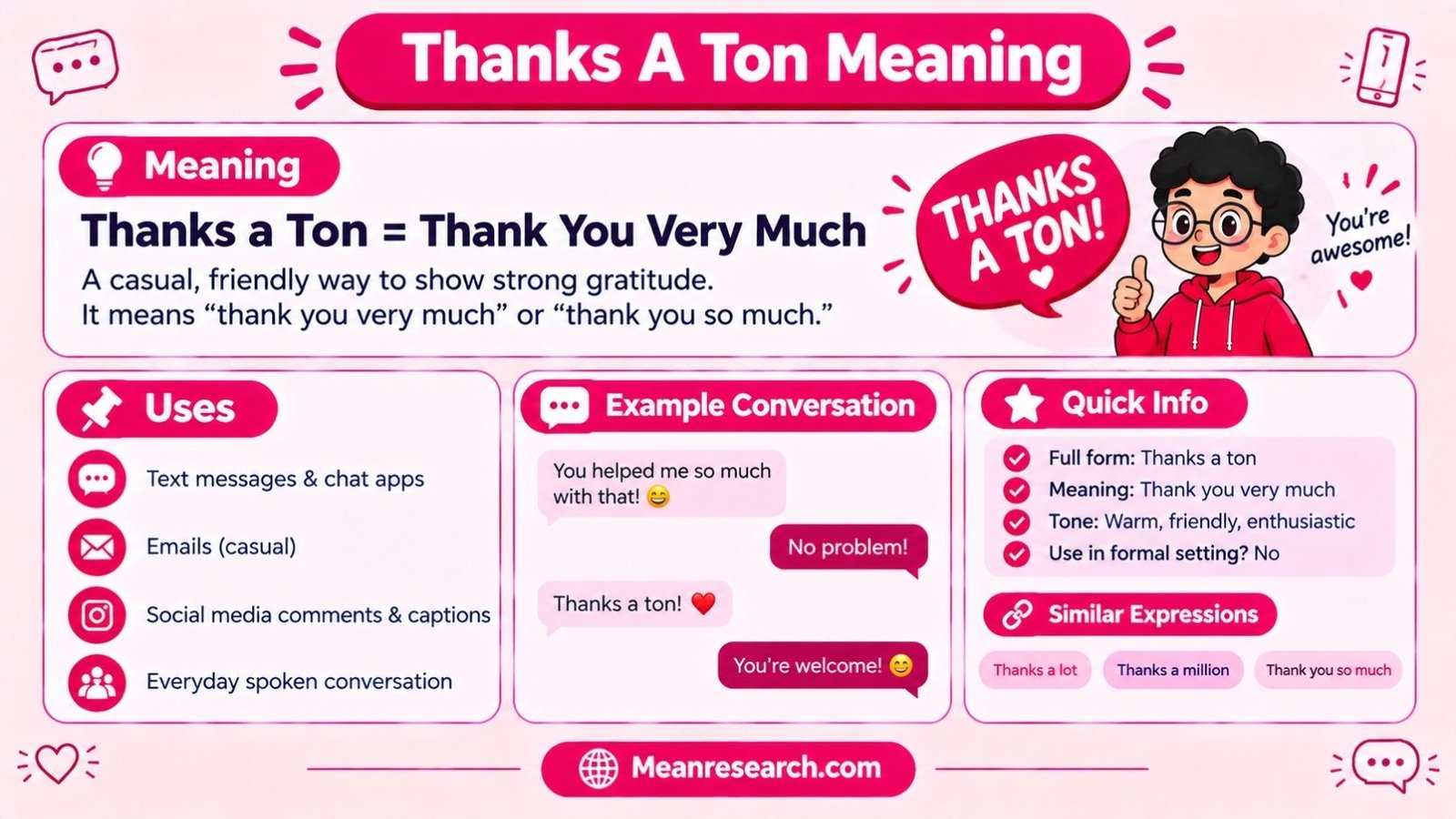
“Thanks a ton” means “thank you very much” or “thank you so much.” It is an informal, friendly way to show strong gratitude. The word “ton” is not literal here. It is used to exaggerate, showing that your thanks are big and heartfelt.
People use this phrase in everyday conversation, texting, and casual writing. It works in personal messages, friendly emails, and quick replies. Understanding its exact meaning helps you use it naturally, without sounding stiff or overly formal in situations where warmth matters more than politeness rules.
What Does “Thanks A Ton” Mean?
“Thanks a ton” is a casual expression of strong appreciation. It simply means “thank you a lot.”
The phrase uses exaggeration on purpose. A “ton” is a unit of weight, roughly 2,000 pounds. Nobody is measuring gratitude in pounds. The word is used loosely, the same way people say “a million thanks” or “tons of fun.” It signals that the speaker’s thanks are large, warm, and genuine, not that anything is being weighed.
You will most often hear or read this phrase in:
- Text messages and chat apps
- Emails between friends or coworkers
- Social media comments and captions
- Everyday spoken conversation
It rarely appears in formal writing, legal documents, or official business letters. In those settings, “thank you very much” or “I sincerely appreciate it” fits better.
Read More: MYB Meaning
Thanks A Ton Meaning In English (Simple Definition)
In plain English, “thanks a ton” means:
“Thank you very much” or “Thanks so much.”
It carries the same core message as “thanks a lot,” but it often sounds a little more enthusiastic. Native English speakers use it to add warmth to a simple thank-you, especially when someone has done something helpful, kind, or unexpected.
Here is a quick way to picture the meaning:
| Phrase | Simple Meaning | Tone |
| Thanks a ton | Thank you very much | Casual, warm |
| Thanks a lot | Thank you very much | Casual, can be sincere or sarcastic |
| Thank you very much | Formal thanks | Neutral to formal |
Grammar And Part Of Speech
“Thanks a ton” is an idiomatic expression, not a single word with one fixed grammatical label. It functions as an interjection, a short phrase used to express a reaction or feeling on its own.
Breaking it down:
- Thanks: a plural noun used as an exclamation of gratitude. It comes from the same root as “thank,” used informally on its own instead of the fuller “thank you.”
- A ton: a noun phrase, literally meaning “a large unit of weight.” Here, it works as an intensifier, adding emphasis to “thanks,” similar to how “a lot” or “loads” work in casual speech.
Grammatically, the full phrase behaves like a fixed expression. Native speakers do not usually change its word order or grammar. You say “thanks a ton,” not “a ton of thanks” or “thank a ton,” when using it as a spoken exclamation.
💡 Tip: Because it is an interjection, “thanks a ton” usually stands alone as a complete reaction, often followed by a period or exclamation mark, not built into a longer formal sentence.
How To Pronounce “Thanks A Ton”
The pronunciation is simple and follows normal English word stress.
- Thanks — sounds like thangks (rhymes with “banks”)
- A — a short, quick “uh” sound
- Ton — sounds like tuhn (rhymes with “fun” and “run”)
Said together, it flows naturally: THANGKS-uh-TUHN, with slightly stronger stress on “thanks” and “ton,” and the word “a” spoken quickly and softly in between. This pattern is consistent in both American and British English, with no major regional pronunciation differences.
Origin Of “Thanks A Ton”
There is no single documented date or inventor behind “thanks a ton.” It grew out of a broader pattern in English where units of weight or large quantities are used to exaggerate feelings or amounts. Expressions like “thanks a million,” “a ton of work,” and “tons of fun” follow the same idea.
“Ton” has long been used informally in English to mean “a large amount” of almost anything, not just physical weight. Over time, pairing it with “thanks” became a natural, casual way to make a simple thank-you feel bigger and more heartfelt. This kind of hyperbole, using a big number or big unit to show strong feeling, is common across informal English expressions and is not unique to this phrase.
Thanks A Ton Meaning In Different Languages
Because “thanks a ton” is searched widely across South Asia, here is how the same warm, informal meaning is typically expressed in several major languages. These are natural, commonly used equivalents rather than word-for-word translations, since “ton” itself does not translate directly.
Thanks A Ton Meaning In Hindi
In Hindi, the closest natural equivalent is “बहुत बहुत धन्यवाद” (bahut bahut dhanyavaad) or the more casual “बहुत शुक्रिया” (bahut shukriya). Both mean “thank you very much” and carry the same warm, informal tone as the English phrase.
Thanks A Ton Meaning In Urdu
In Urdu, “thanks a ton” is commonly expressed as “بہت شکریہ” (bohot shukriya), meaning “thank you very much.” It is used in everyday speech among friends, family, and colleagues, matching the casual tone of the English phrase.
Thanks A Ton Meaning In Telugu
In Telugu, the phrase translates naturally to “చాలా ధన్యవాదాలు” (chala dhanyavadalu), meaning “many thanks” or “thank you very much.”
Thanks A Ton Meaning In Tamil
In Tamil, a fitting equivalent is “மிக்க நன்றி” (mikka nandri), meaning “great thanks” or “thank you very much.”
Thanks A Ton Meaning In Gujarati
In Gujarati, the phrase is commonly expressed as “ખૂબ ખૂબ આભાર” (khoob khoob aabhar), meaning “thank you very much.”
Read More: Happiest Birthday Meaning
Thanks A Ton Meaning In Marathi
In Marathi, “thanks a ton” corresponds to “खूप खूप धन्यवाद” (khup khup dhanyavaad), again meaning “thank you very much.”
Thanks A Ton Meaning In Bengali
In Bengali, the natural equivalent is “অনেক ধন্যবাদ” (onek dhonnobad), meaning “many thanks” or “thank you very much.”
📝 Note: None of these languages have a word-for-word match for “ton” used this way. Each version instead uses its own natural way of intensifying “thank you,” which is why translations focus on meaning rather than literal wording.
How Is “Thanks A Ton” Used?
“Thanks a ton” fits naturally into casual and semi-casual situations. Here is how it typically appears in real conversation.
In texting and chat:
“Got the file, thanks a ton!”
In casual emails:
“Thanks a ton for turning this around so quickly.”
In spoken conversation:
“You fixed my laptop? Thanks a ton, seriously.”
In social settings:
“Thanks a ton for coming to the party!”
It works well when someone has genuinely helped you, and you want your gratitude to feel warm rather than routine. It is less suitable for formal reports, official correspondence, or situations requiring a strict professional tone, where “thank you very much” or “I greatly appreciate your assistance” is safer.
Examples Of “Thanks A Ton” In A Sentence
- “Thanks a ton for covering my shift today, I really owe you one.”
- “It’s really lovely, thanks a ton for the thoughtful gift.”
- “So kind of you, thanks a ton for helping me move this weekend.”
- “Thank you and thanks a ton for your patience while we sorted this out.”
Each example shows the phrase attached to a specific reason for gratitude, which is how it is most naturally used. Saying it alone, without context, still works, but pairing it with a reason makes the thanks feel more sincere and specific.
Thanks A Ton vs Thanks A Lot vs Thanks A Million
These three phrases are close in meaning but carry slightly different shades of tone.
| Phrase | Meaning | Typical Tone |
| Thanks a ton | Thank you very much | Warm, casual, enthusiastic |
| Thanks a lot | Thank you very much | Can be sincere, but often used sarcastically |
| Thanks a million | Thank you very much | Very enthusiastic, slightly more dramatic |
⚠️ Common mistake: Many learners assume “thanks a lot” is always polite. In everyday spoken English, it is frequently used sarcastically, for example, after something goes wrong: “Thanks a lot for that,” said with a flat or annoyed tone. “Thanks a ton” does not usually carry this sarcastic use, which makes it a safer, more consistently warm choice.
Common Mistakes To Avoid
❌ Incorrect: “Thank a ton for your help.”
✅ Correct: “Thanks a ton for your help.”
The phrase always uses “thanks,” the plural exclamation form, not “thank” as a verb command.
❌ Incorrect: “A ton of thanks for coming.”
✅ Correct: “Thanks a ton for coming.”
While “a ton of thanks” is grammatically understandable, it is not the fixed idiomatic form. Native speakers consistently say “thanks a ton,” keeping the word order set.
❌ Incorrect: Using “thanks a ton” in a formal business letter or legal document.
✅ Correct: Using “thank you very much” or “I sincerely appreciate your assistance” in formal writing.
The phrase is casual by nature, so it should be reserved for informal or semi-informal communication.
Similar Words And Related Expressions
| Expression | Meaning | Difference |
| Thanks a lot | Thank you very much | Can sound sincere or sarcastic depending on tone |
| Thanks a million | Thank you very much | More dramatic, often used for big favors |
| Much appreciated | I appreciate this | Slightly more neutral, works in semi-formal settings |
| Thank you so much | Thank you very much | Warm and widely accepted in almost any setting |
| I’m so grateful | I feel deep gratitude | More emotional, often used for meaningful help |
Each of these expressions shares the core idea of strong thanks, but they differ slightly in formality and emotional weight. “Thanks a ton” sits comfortably in the casual, friendly middle ground, warmer than a plain “thanks,” but less formal than “thank you very much.”
Read More: TS Meaning Slang
Frequently Asked Questions
What does “thanks a ton” mean?
It means “thank you very much.” It is an informal way to express strong gratitude, using “ton” as an exaggeration rather than a literal measurement.
Is “thanks a ton” formal or informal?
It is informal. It works well in everyday conversation, texting, and casual emails, but it is not suitable for formal or official writing.
Is “thanks a ton” a noun or a verb?
It functions as an interjection, a short phrase used to express a reaction. “Thanks” is a plural noun used as an exclamation, and “a ton” is a noun phrase used for emphasis.
How do you pronounce “thanks a ton”?
It is pronounced “thangks-uh-tuhn,” with light stress on “thanks” and “ton,” and a quick, soft “a” in between.
What is the difference between “thanks a ton” and “thanks a lot”?
Both mean “thank you very much,” but “thanks a lot” is sometimes used sarcastically, while “thanks a ton” almost always carries a warm, sincere tone.
Can I use “thanks a ton” in a work email?
Yes, if the workplace culture is casual and the email is between colleagues who know each other well. For formal or external business communication, “thank you very much” is safer.
Is “thanks a tonne” also correct?
“Tonne” is the British spelling for a metric ton, while “ton” is the standard spelling used in this idiom. In everyday use, “thanks a ton” is by far the more common and recognized spelling, even in British English.
What does “thanks a ton” mean in Hindi?
It is commonly expressed as “बहुत बहुत धन्यवाद” (bahut bahut dhanyavaad) or “बहुत शुक्रिया” (bahut shukriya), both meaning “thank you very much.”
Conclusion
“Thanks a ton” is a simple, informal way of saying “thank you very much.” It uses the word “ton” as a playful exaggeration to show that your gratitude is big and genuine, not to describe an actual weight or amount. The phrase fits naturally into texting, casual emails, and everyday conversation, and it carries a warmer, more enthusiastic tone than a plain “thanks.”
Knowing when and how to use “thanks a ton” helps you sound natural rather than overly formal or stiff. Save it for casual and friendly situations, choose “thank you very much” for formal writing, and remember that across Hindi, Urdu, Telugu, Tamil, Gujarati, Marathi, and Bengali, the same warm feeling behind “thanks a ton” comes through clearly, even without a direct translation for the word “ton” itself.

Hooriya Salman is the writer and researcher behind Mean Research, with 4 years of experience researching and writing about word meanings, slang, names, and everyday language. Their aim is to provide clear, accurate, and easy-to-understand explanations that help readers discover the meaning behind unfamiliar words, expressions and names.
One Comment