
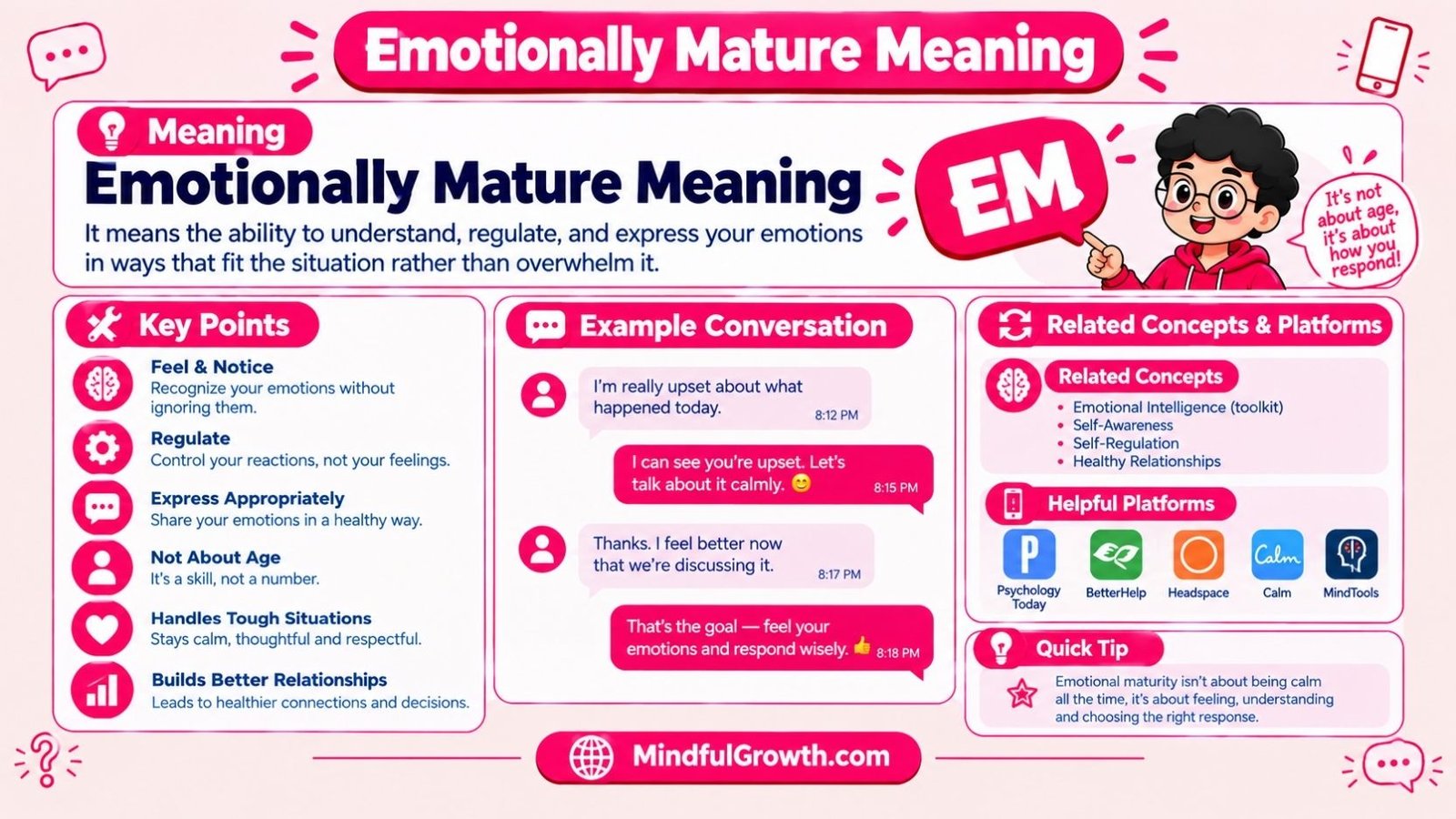
Emotionally mature meaning refers to a person’s ability to understand, regulate, and express their emotions in ways that fit the situation rather than overwhelm it. It is not about age or how many birthdays someone has celebrated. It is about how someone responds when life gets difficult, uncertain, or emotionally charged.
The American Psychological Association describes this quality in clear terms. Emotional maturity is “a high and appropriate level of emotional control and expression.” The opposite, emotional immaturity, shows up as reacting without restraint or responding in a way that is far bigger than the situation actually calls for.
This guide breaks the concept down completely. You will learn what emotional maturity means in psychology, how it differs from emotional intelligence, what it looks like in relationships, and how to recognize both the presence and the absence of it in yourself and others.
What Does Emotionally Mature Actually Mean
At its core, being emotionally mature means you can feel a strong emotion without letting that emotion completely run your behavior. Anger, disappointment, jealousy, and fear still show up in your life, because you are human. The difference is in what happens next.
An emotionally mature person notices the feeling, gives it a name, and chooses a response that fits the moment. They do not pretend the emotion is not there. They also do not let it hijack every decision they make for the rest of the day.
Alleydog’s psychology glossary frames it this way: emotional maturity is the ability to appropriately respond to various situations, rationally control one’s actions in response to one’s feelings, and act in a non-childish way. That definition captures something important. Maturity is not the absence of emotion. It is the presence of thoughtful control.
Quick Definition Box:
Emotionally mature meaning, in simple terms: the capacity to feel your emotions fully while still responding to people and situations in a way that is proportionate, respectful, and self-aware.
Read More: API Meaning
Emotional Maturity In Psychology: The Deeper Explanation
Psychologists treat emotional maturity as a developmental skill rather than a fixed personality trait. That distinction matters a great deal, because it means maturity is something a person can build over time through practice, reflection, and sometimes therapy.
Research published through the Positive Psychology organization frames emotional maturity as the real-world expression of emotional skill. Emotional maturity is the manifestation of emotional skills through consistent, appropriate emotional responses and behaviors. That framing is useful because it shows maturity as something visible in daily conduct, not just an inner feeling.
A degree of self-understanding sits at the center of this. According to American Behavioral Clinics, an emotionally mature person has reached a level of self-understanding with regard to their thoughts and behaviors, then decides how to best approach and cope with challenging situations. This process never fully finishes. Even highly self-aware adults keep refining how they handle stress, conflict, and disappointment throughout their lives.
Academic literature echoes this pattern. A peer-reviewed paper on emotional maturity describes it as the stage for expressing appropriate emotions at the appropriate time and in the appropriate amount. Notice the emphasis on timing and proportion. That is really the whole concept in one sentence.
Why Emotional Maturity Is Not About Suppressing Feelings
A common myth treats emotional maturity as being calm, quiet, and unbothered at all times. That picture is inaccurate and even a little harmful, because it pushes people to hide what they feel instead of processing it honestly.
American Behavioral Clinics directly addresses this misconception. Being emotionally mature does not mean suppressing emotions. Suppression tends to build pressure that leaks out later, often in a much less controlled way than if the feeling had been acknowledged from the start.
Real maturity involves feeling something fully, naming it honestly, and then choosing a response that will not damage a relationship or a goal. That is a very different skill than simply pushing feelings down and pretending they do not exist.
Emotional Maturity Vs Emotional Intelligence: What Is The Real Difference
People often use these two terms as if they mean the same thing, but psychologists draw a clear line between them. Understanding the difference will help you use both concepts correctly, whether you are describing yourself, a partner, or a coworker.
Emotional intelligence is the underlying skill set. Positive Psychology explains that emotional intelligence refers to the ability to navigate our own emotions and those of others, and it includes skills like emotional awareness, empathy, and effective communication. Think of it as the toolkit sitting in the background of a person’s mind.
Emotional maturity is what happens when that toolkit gets used consistently and appropriately in real life. As Positive Psychology puts it, emotional maturity is the manifestation of these skills through consistent, appropriate emotional responses and behaviors. In other words, intelligence is the capacity, and maturity is the track record of actually applying it.
| Aspect | Emotional Intelligence | Emotional Maturity |
| What it is | A set of underlying skills and abilities | The consistent real world application of those skills |
| Focus | Awareness, empathy, communication ability | Behavior, self-control, and appropriate response |
| Can exist without the other | Yes, someone can understand emotions in theory but still react poorly | No, maturity depends on having some baseline emotional awareness |
| How it is built | Through self-reflection, feedback, and learning | Through practice, repeated experience, and intentional growth |
| How it shows up | In how well someone reads a room or names a feeling | In how someone actually behaves under pressure |
Note Box:
A person can be high in emotional intelligence and still act immaturely in the moment. Knowing exactly why you are angry does not automatically stop you from raising your voice. Maturity is the bridge between understanding a feeling and choosing a wise response to it.
Signs Of Emotional Maturity In A Relationship
Romantic relationships put emotional maturity to the test more than almost anything else in daily life. When two people are emotionally invested in each other, small frictions can turn into large conflicts if either partner lacks the skill to manage their reactions.
A CBT-focused clinical resource identifies four core abilities behind relational maturity. It rests on knowing yourself and identifying your emotions accurately, regulating your reactions to relational challenges without excessive reactivity, showing empathy by putting yourself in your partner’s shoes, and communicating your needs and feelings effectively. Those four pillars show up again and again across clinical writing on the subject.
Communication style is often the clearest tell. According to a Forbes piece written by a psychologist, when a partner is emotionally mature, communication feels like a two way street, they ask good questions, and they take a moment before answering instead of interrupting with tension or deflection. That pause before responding is a small behavior with a large impact on how safe a relationship feels.
Boundaries matter too, and mature partners treat them as helpful rather than threatening. As one relationship resource explains, in an emotionally mature relationship, boundaries are valued rather than seen as something negative, and both partners set and respect them. This reframes boundaries from a wall that keeps people apart into a structure that actually protects the connection.
Signs Of Emotional Maturity In A Relationship: Quick List
- They own their mistakes instead of deflecting blame onto their partner
- They can sit with an uncomfortable conversation instead of shutting down or walking away
- They ask questions during conflict instead of assuming they already know the answer
- They respect boundaries without treating them as a personal rejection
- They apologize specifically, naming what they did wrong rather than offering a vague sorry
- They can express disappointment without turning it into an attack
Emotional Flexibility As A Relationship Skill
One study covered by Psychology Today looked closely at how emotionally intelligent people manage conflict inside relationships. The researchers found that individuals scoring high in emotional intelligence used strategies such as cognitive reappraisal, actively changing their perspective on a situation to reduce its emotional impact, along with selective emotional suppression when maintaining the relationship mattered more than venting in that moment.
That second strategy often gets misunderstood. It does not mean bottling everything up forever. It means recognizing that not every irritation needs to be voiced the second it appears, especially if saying it right then would do more harm than good.
A separate 2017 study referenced in relationship psychology research looked at what the field calls romantic competence, described as a blend of emotional awareness, mutual respect and self-regulation in developing intimacy. The researchers found this competence shaped how much positive emotion each partner was able to express and receive within the relationship.
Emotionally Mature Meaning In Relationship: A Closer Look At Communication
When people search for emotionally mature meaning in relationship contexts specifically, they are usually trying to figure out whether their partner, or they themselves, healthily handle conflict and vulnerability.
Emotional maturity in this setting is less about grand gestures and more about the small, repeated choices that build or erode trust. Choosing to listen instead of interrupting. Choosing to ask instead of assume. Choosing to take a breath before responding when hurt.
One clinical resource ties this directly to accountability. Emotional maturity is practicing responsibility, which includes owning emotions, making adaptive decisions, and making an effort to connect even when it is uncomfortable. That final point, staying engaged even when it is uncomfortable, separates mature partners from those who withdraw the moment things get hard.
The same resource contrasts this with emotional unavailability. Emotional unavailability frequently shows up as avoiding vulnerability, struggling to express emotions, or persistently staying on the surface of a conversation. Recognizing this pattern in yourself is often the first real step toward change.
Quick Tip Box:
If you want a simple gauge for emotional maturity in a relationship, watch what happens during the first sixty seconds of a disagreement. Mature partners slow down. Immature patterns speed up, with raised voices, interruptions, or a sudden exit from the room.
What Are The Four Types Of Emotional Maturity
People searching for what are the four types of emotional maturity are usually looking for a structured way to understand the concept, since psychology does not present a single official numbered list of types. Instead, the field generally organizes emotional maturity around four core abilities that work together.
Based on clinical psychology sources, these four components are consistently described as the building blocks of a mature emotional life:
- Self awareness. Knowing what you feel and why you feel it, rather than experiencing emotion as a confusing fog.
- Emotional regulation. The capacity to manage the intensity of a reaction so it fits the situation instead of overwhelming it.
- Empathy. The ability to step outside your own perspective and genuinely understand what another person might be feeling.
- Effective communication. Translating internal emotional experience into words other people can actually understand and respond to.
A CBT resource lists these same four elements almost identically, describing emotional maturity as resting on knowing yourself and identifying your emotions accurately, regulating your reactions without excessive reactivity, showing empathy by putting yourself in another person’s shoes, and communicating your needs and feelings effectively.
Comparison Table: The Four Components In Action
| Component | What It Looks Like When Present | What It Looks Like When Missing |
| Self awareness | Naming feelings accurately, noticing triggers before reacting | Feeling “off” without understanding why, reacting on autopilot |
| Emotional regulation | Pausing before responding, matching reaction to the actual size of the problem | Overreacting to small issues, or completely shutting down under stress |
| Empathy | Asking how someone else experienced a situation | Assuming your own perspective is the only valid one |
| Communication | Expressing needs clearly and calmly | Hinting, sulking, or expecting others to read your mind |
Signs Of Emotional Maturity In A Woman
Search interest around signs of emotional maturity in a woman usually reflects a desire to understand how emotional maturity shows up day to day, rather than a claim that maturity looks different by gender at a biological level. The underlying traits are the same ones described throughout psychological research: self-awareness, regulation, empathy, and clear communication.
That said, several behavioral signs tend to get highlighted in relationship and self-development contexts when people describe a mature woman, partner, friend, or colleague:
- She can disagree with someone without needing to attack their character
- She takes responsibility for her part in a conflict instead of only focusing on what the other person did wrong
- She sets boundaries clearly and does not expect others to guess her limits
- She can be disappointed without making everyone around her responsible for fixing her mood
- She asks for what she needs directly instead of testing whether someone will notice on their own
- She can sit with uncertainty instead of demanding immediate resolution to every open question
These signs apply equally to emotionally mature men, and clinical sources generally frame maturity as a universal human skill rather than something tied to one gender. The traits above are simply common, observable expressions of the same underlying psychological capacity.
What Age Does A Person Fully Emotionally Mature
This is one of the most searched questions on the topic, and the honest answer is more nuanced than a single number. Popular culture often cites age 25 as the moment the brain, and by extension emotional maturity, becomes fully formed. The real picture is more complicated.
The prefrontal cortex, the brain region most closely tied to planning, impulse control, and emotional regulation, is genuinely the last part of the brain to finish developing. Simply Psychology explains that the prefrontal cortex does not fully mature until around age 25, making it the last part of the brain to fully develop, and this extended timeline helps explain why teenagers often struggle with emotional regulation, risk assessment, and long-term thinking.
However, more recent neuroscience pushes back on treating 25 as a hard cutoff. The Conversation reported that more advanced brain regions involved in decision-making, emotional regulation, and social behavior had not fully matured by the final brain scans around age 20 in early studies, and since the data collection stopped at that age, researchers could not say precisely when development finished, so age 25 became the best estimate rather than a confirmed endpoint.
An even more detailed picture shows that different brain structures finish developing at very different times. According to ScienceInsights, structures like the basal ganglia peak around ages 12 to 14, the thalamus peaks around 19, and the hippocampus and amygdala, both critical for memory and emotional processing, do not reach maximum volume until roughly age 23.
Read More: Smirking Face Meaning
Warning Box:
Do not treat any single age as a guarantee of emotional maturity. Brain development sets the stage for the capacity to regulate emotions, but actual maturity still depends heavily on life experience, self-reflection, relationships, and sometimes therapy. Plenty of adults well past 25 still struggle with emotional regulation, and plenty of younger adults show remarkable maturity because of what they have lived through.
There is also a well documented gender difference in the timing of frontal lobe development. One clinical source notes that the frontal lobe typically reaches full development around age 25 in females, with the brain’s maturation process in women tending to run slightly ahead of men. Even so, brain maturity and emotional maturity are related but not identical concepts, since emotional maturity also depends on lived experience and intentional growth.
Signs Of Emotional Immaturity: The Opposite Pattern
Understanding what emotional maturity is not helps sharpen the definition considerably. The APA’s own framing of the opposite condition is direct and useful here.
According to the APA Dictionary of Psychology, as cited by a clinical resource, emotional immaturity is “a tendency to express emotions without restraint or disproportionately to the situation.” That single phrase, without restraint or disproportionately, captures the core problem. It is not that the emotion itself is wrong. It is that the response does not match the moment.
Clinical writing lists several recognizable patterns connected to this kind of immaturity:
- Impulsive behavior. Acting on a feeling immediately, without pausing to consider consequences.
- Attention seeking. Needing constant reassurance or validation, especially during emotional moments.
- Difficulty identifying emotions. Struggling to identify and comprehend one’s own feelings, then reacting impulsively without understanding the underlying trigger.
- Limited empathy. Struggling to understand and resonate with the emotions of others, which often leads to strained relationships.
FAQ Style Note:
Someone asking about what not being emotionally mature means is usually describing this exact pattern: reactions that are bigger than the situation calls for, difficulty naming what they feel, and trouble seeing things from another person’s point of view.
Emotional Maturity Examples You Can Recognize In Daily Life
Abstract definitions are useful, but concrete examples make the concept click. Here are realistic situations that show the difference between a mature and an immature response to the exact same trigger.
| Situation | Immature Response | Mature Response |
| A partner cancels plans last minute | Silent treatment for the rest of the night | Saying you feel disappointed and asking what happened |
| A coworker gets credit for your idea | Complaining about it to everyone except that person | Speaking directly to the coworker or manager about it |
| Being criticized at work | Getting defensive and listing all the things you do right | Asking a clarifying question and considering the feedback |
| A friend forgets your birthday | Bringing it up passive aggressively for weeks | Mentioning honestly that it hurt your feelings |
| Losing an argument | Refusing to speak to the other person | Acknowledging the other point had merit, even if it stings |
Real World Example:
Picture two employees receiving the exact same critical feedback from a manager. One employee goes quiet, avoids the manager for the rest of the week, and complains to coworkers. The other employee asks one clarifying question, thanks the manager for the honesty, and makes a visible change the following week. The second employee is demonstrating emotional maturity in a very ordinary, very human workplace moment.
How Emotional Maturity Builds Trust And Connection
Emotional maturity is not just a nice personality trait. Research increasingly connects it to the quality and stability of relationships across every context, from romance to family to the workplace.
Psychology Today describes emotional maturity as foundational to healthy connection. In many ways, emotional maturity is the foundation of psychological well being and successful interpersonal functioning, shaping how someone shows up in a relationship, not just romantically but in friendships, families, and workplaces.
Predictability plays a surprisingly large role in why this matters. The same source explains that emotionally mature people create emotional safety because they are predictable in the best way, they do not explode when upset, ghost when overwhelmed, or manipulate to get what they want, and this predictability fosters trust and psychological safety.
Self-awareness also signals something important to other people. When someone owns their mistakes and can reflect on their own behavior, it communicates a high level of emotional intelligence, an essential trait for long term relational success. Owning a mistake sounds small, but it is one of the clearest, most consistent signals of maturity that researchers and clinicians point to.
How Emotional Maturity Is Developed
A common myth suggests that people are simply born mature or not. Clinical psychology firmly disagrees with that idea, treating emotional maturity as a trainable skill rather than a fixed trait someone either has or lacks.
Positive Psychology states this plainly. Emotional maturity is a skill that can be nurtured and developed through psychoeducation, therapy, and coaching. That means structured support, whether through a therapist, a coach, or deliberate self-study, genuinely moves the needle.
Four specific methods come up repeatedly in the research literature as effective paths toward growth. Positive Psychology identifies these as therapy, mindfulness, journaling, and self reflection, describing them as the key methods that can guide a person’s journey toward greater emotional maturity.
Ways To Build Emotional Maturity: Practical Checklist
- Name your emotions specifically instead of using vague words like fine or bad
- Pause for a few seconds before responding when you feel triggered
- Journal after emotionally intense moments to spot recurring patterns
- Ask yourself what a calm version of you would do in this situation
- Practice apologizing for specific actions rather than offering a general sorry
- Seek therapy or coaching if certain patterns keep repeating despite your best efforts
Resilience also plays a direct role in this growth process. Positive Psychology notes that all personal growth requires the capacity to recover quickly from difficulties and adapt to change. Emotional maturity, in that sense, is really the accumulated result of recovering from setbacks again and again over time, and getting a little better at it each time.
Emotional Maturity Test: What To Expect
People searching for an emotional maturity test are usually hoping for a structured way to measure where they currently stand. While there is no single universally standardized clinical test that every psychologist uses, several self-assessment frameworks draw on the same core components described throughout this guide.
A genuine self-assessment typically asks you to reflect honestly on questions like these:
- Do I usually know why I am upset, or does it take me a while to figure it out
- When I am angry, do I pause before speaking, or do words come out immediately
- Can I apologize specifically, or do I tend to explain myself instead of owning the mistake
- Do I notice how my mood affects the people around me
- Can I hear criticism without becoming defensive
- Do I set boundaries clearly, or do I expect people to guess my limits
Note Box:
Any informal quiz you find online is a self-reflection tool, not a clinical diagnosis. If you are concerned about a genuine pattern of emotional dysregulation affecting your relationships or daily functioning, a licensed therapist can offer a far more accurate and personalized assessment than any online quiz.
Emotionally Mature Meaning In Hindi, Urdu, And Other Languages
Many readers search for this term with a specific language in mind, wanting to understand or explain the concept in their native tongue. While the psychological concept stays consistent worldwide, the phrase translates roughly as follows across several commonly searched languages:
| Language | Approximate Translation Concept |
| Hindi | Bhavnatmak roop se parichit vyakti, meaning someone who is emotionally well developed and self-aware |
| Urdu | Jazbati taur par pukhta shakhs, referring to a person with balanced and controlled emotional responses |
| Marathi | Bhavnikdrishtya prauddha vyakti, describing someone emotionally grown and self-regulated |
| Bengali | Abegik dik diye paripakko byakti, meaning a person mature in their emotional handling |
| Tamil | Unarchi ritiyaaga mutthirchi adaintha nபer, describing someone who has reached emotional readiness |
| Telugu | Bhavodvegapara pakvata kaligina vyakti, referring to someone emotionally settled and balanced |
| Malayalam | Vikaravasathayil paakwatha nediya vyakti, describing a person who has attained emotional steadiness |
These translations describe the same underlying idea found throughout the English language psychological literature: a person who can feel deeply while still responding with balance, self-control, and awareness of others.
Simple, Graceful And Emotionally Mature: What That Combination Means
Some readers search for the phrase simple graceful and emotionally mature, often looking for a description of an ideal personal quality rather than a strict clinical term. In everyday language, this combination points to someone who carries themselves without unnecessary drama, treats others with quiet respect, and handles emotional situations with composure rather than chaos.
This is really emotional maturity expressed through personal presence. Grace, in this context, reflects the outward calm that comes from strong internal emotional regulation. Simplicity reflects a lack of manipulation or hidden agendas in how someone communicates their needs and feelings.
Read More: HG Meaning In Text
Fully Emotionally Mature Meaning: Is It Ever A Finished State
A meaningful number of searches use the phrase fully emotionally mature, which raises an important question. Is emotional maturity something a person eventually completes, like finishing a course, or is it ongoing for life?
Clinical sources consistently describe it as continuous rather than final. American Behavioral Clinics states this directly: emotional maturity is always an active work in progress, and it is not a situation where a certain level of self understanding is reached once and then remains static in all situations moving forward.
This means the phrase fully emotionally mature is best understood as a description of someone who consistently demonstrates strong emotional skills across most situations, rather than someone who has reached some permanent, unchangeable endpoint. Even highly emotionally skilled people encounter new situations, new relationships, and new stressors that test and refine their regulation abilities throughout their entire lives.
Frequently Asked Questions
What does emotionally mature mean in simple words?
It means responding to your feelings in a way that fits the situation, instead of overreacting, shutting down, or blaming others.
Is emotional maturity the same as emotional intelligence?
No. Emotional intelligence is the underlying skill set, while emotional maturity is how consistently that skill shows up in real behavior.
Can someone become more emotionally mature over time?
Yes. Clinical psychology treats it as a learnable skill, often developed through therapy, mindfulness, journaling, and self-reflection.
At what age does someone become emotionally mature?
There is no fixed age. Brain regions tied to regulation continue developing into the mid twenties, but true maturity depends heavily on life experience too.
What is a common sign of emotional immaturity?
Reacting to a situation with an emotional response that is far bigger, or far more restrained, than what the situation actually calls for.
Does being emotionally mature mean never getting upset?
No. It means still feeling upset fully, while choosing a response that does not damage the relationship or situation.
How can I tell if my partner is emotionally mature?
Watch how they communicate during disagreements. Mature partners ask questions, avoid deflection, and treat your boundaries with respect.
Is emotional maturity different for men and women?
The core psychological traits are the same for everyone. Any differences tend to be about socialization and communication style, not the underlying skill itself.
What is the opposite of emotional maturity called?
Psychologists refer to it as emotional immaturity, defined by the APA as expressing emotions without restraint or disproportionately to the situation.
Can therapy help with emotional maturity?
Yes. Therapy is one of the most consistently recommended paths for developing stronger emotional regulation, self-awareness, and communication skills.
Final Thoughts
Emotionally mature meaning ultimately comes down to one simple but demanding skill: feeling your emotions honestly while still choosing responses that fit the moment and respect the people around you. It is not about becoming unemotional or unbothered by life’s challenges.
Real maturity shows up in small, repeated choices. Pausing before reacting. Naming a feeling instead of acting it out. Apologizing specifically instead of deflecting. Respecting a boundary instead of taking it personally. None of these choices require perfection, and none of them arrive automatically with age alone.
What they do require is intention, honest self-reflection, and a willingness to keep growing, which is exactly why psychologists describe emotional maturity not as a destination you reach, but as a lifelong practice you keep returning to.

Hooriya Salman is the writer and researcher behind Mean Research, with 4 years of experience researching and writing about word meanings, slang, names, and everyday language. Their aim is to provide clear, accurate, and easy-to-understand explanations that help readers discover the meaning behind unfamiliar words, expressions and names.
2 Comments