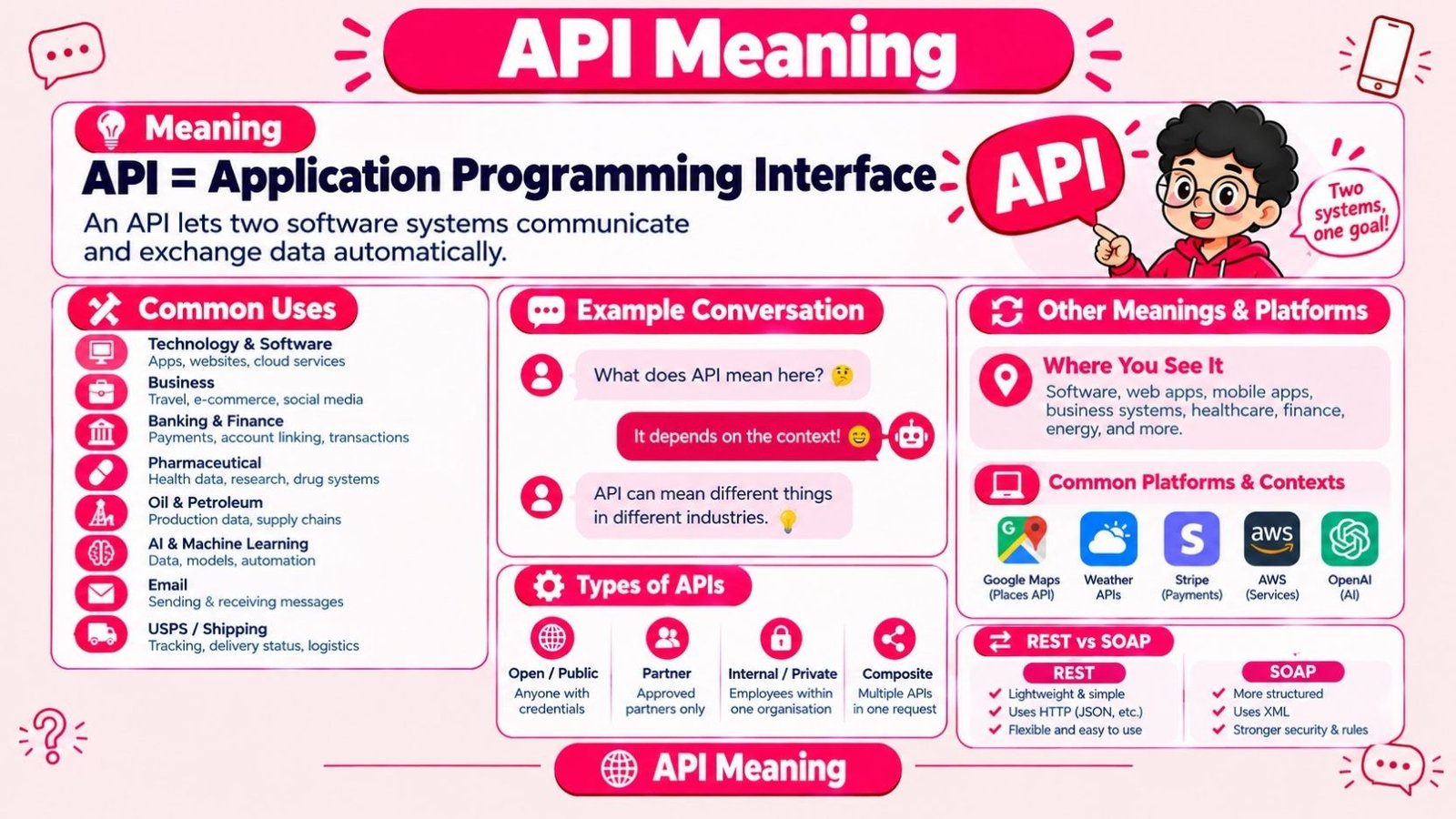
API meaning refers to Application Programming Interface, a set of rules that lets two software systems talk to each other and share data automatically. That single definition sits at the center of modern technology, but the letters API also carry entirely different meanings in pharmaceuticals, oil and gas, banking, and medicine.
This guide breaks down every version of API meaning you are likely to encounter, explains how each one works in plain English, and shows you exactly where the term applies in real life.
What Does API Stand For?
API stands for Application Programming Interface. In computing, it is a mechanism that enables two software components to communicate with each other using a set of definitions and protocols. Think of it as a formal agreement between two pieces of software about how they will exchange information.
The word breaks down cleanly once you separate it into its three parts. Application refers to any piece of software with a distinct purpose, whether that is a mobile app, a website, or a server. Programming Interface refers to the layer that lets one program interact with another without either side needing to understand the other’s internal code.
You do not need to be a developer to benefit from APIs every day. The weather bureau’s software system contains daily weather data, and the weather app on your phone talks to this system through APIs to show you daily weather updates. That same pattern repeats across ride sharing apps, payment systems, travel booking sites, and social media platforms.
Read More: TBM Meaning
API Meaning In Simple Words
Picture a restaurant with a kitchen and a waiter. You never walk into the kitchen to tell the chef what you want, and the chef never comes to your table to ask. The waiter carries your order back and communicates the finished dish to you, acting as the go-between that neither side has to understand the other’s process.
An API plays the same role between two computer systems. Your phone app is the customer, the company’s server is the kitchen, and the API is the waiter carrying requests and responses back and forth. Neither the app nor the server needs to know how the other one is built internally.
This is exactly the concept explained by IBM’s documentation team. An API is a set of rules or protocols that enables software applications to communicate with each other to exchange data, features, and functionality. That single idea, communication without needing to see inside the other system, explains almost every use case you will find in this article.
How Does An API Work?
Every API interaction follows a request and response cycle. Your app, called the client, sends a structured request to another system, called the server. The server processes that request and sends back a response, usually containing the data or confirmation the client asked for.
API architecture is usually explained in terms of client and server, where the application sending the request is the client and the application sending the response is the server. Their documentation defines exactly how those requests and responses must be structured so both sides understand each other perfectly.
Quick Tip: If an app tells you it “pulled live data” or “connected your account,” an API almost always did the actual work behind that sentence. The visible app is just the interface you tap on.
Here is a simplified walkthrough using an online checkout as the example.
- You click “Pay Now” on a shopping website.
- The website’s software sends an API request to a third party payment processor like Stripe or PayPal.
- The payment API calls to the external program or web server, and the server sends a response back with the requested information.
- The website receives that response and shows you a confirmation screen.
Types Of APIs You Should Know
Not every API works the same way or serves the same audience. Classifying APIs by who can access them helps explain why some are public and searchable while others stay hidden inside a single company’s systems.
| API Type | Who Can Use It | Common Example |
| Open or Public API | Any developer with credentials | Google Maps API, weather data APIs |
| Partner API | Approved business partners only | Airline booking systems shared with travel agencies |
| Internal or Private API | Employees within one organization | A company’s internal HR data system |
| Composite API | Developers combining multiple data calls | An app pulling flight, hotel, and car data in one request |
Open APIs are open source application programming interfaces accessed with the HTTP protocol and are also known as public APIs, with defined endpoints and request and response formats. Partner APIs and internal APIs restrict access for business or security reasons, while composite APIs simply bundle several calls into one for efficiency.
API Meaning In Technology And Computer Science
In software development, API meaning centers on how programs, devices, and platforms exchange data with each other. An Application Program Interface is built to connect computer systems to each other in order to share data, and it is distinct from a user interface, which connects a computer directly to a person. That distinction matters because a user interface is for humans, while an API is strictly for machines talking to machines.
Developers rely on APIs constantly, and for good reason. APIs let a product or service communicate with other products and services without needing to know how they are implemented, which simplifies app development and saves time and money. Instead of building a mapping system from scratch, a developer simply connects to an existing mapping API and gets that functionality instantly.
REST API Meaning
REST stands for Representational State Transfer, and it is the most widely used API architecture on the internet today. The main feature of a REST API is statelessness, meaning servers do not save client data between requests, and each request functions similarly to typing a URL into your browser. Because of this simplicity, REST has become the default choice for most modern web and mobile applications.
REST APIs organize everything around resources, and each resource gets its own unique web address. RESTful APIs are resource based rather than method based, and HTTP methods are used to perform create, read, update, and delete operations on those resources. This structure is part of why REST feels intuitive to developers who already understand how websites work.
RESTful API Meaning
RESTful API meaning is essentially identical to REST API meaning, and the two terms are used interchangeably in almost every technical conversation. The word “RESTful” simply describes an API that correctly follows REST’s architectural rules rather than only borrowing some of its ideas.
Web APIs are a type of remote API that expose an application’s data and functionality over the internet, and today most APIs are web APIs, which is exactly the category RESTful APIs fall into.
SOAP API Meaning
SOAP stands for Simple Object Access Protocol, and it takes a stricter, more formal approach than REST. Like REST, SOAP provides a way to access services on the internet, but it uses XML to define how requests are formatted and can run on a wide variety of transport protocols. This makes SOAP vendor agnostic, meaning it does not depend on any single company’s technology stack.
SOAP has stayed relevant for decades because of one major strength: security. SOAP has built in message level security through WS Security, which provides encryption and digital signatures independent of the transport layer, and this level of protection is preferred in highly regulated industries like banking and healthcare.
Read More: Smirking Face Meaning
REST API vs SOAP API
| Feature | REST API | SOAP API |
| Data Format | JSON, XML, plain text | XML only |
| Speed | Faster, lightweight | Slower, more overhead |
| Security | Relies on HTTPS and OAuth | Built in WS Security standards |
| Best Fit | Mobile apps, public APIs, web apps | Banking, healthcare, legacy enterprise systems |
| Structure | Flexible, resource-based | Strict, contract-based via WSDL |
Many enterprises use both simultaneously, for example connecting a SOAP based ERP system to a REST-based CRM system, and integration platforms are designed to bridge these different API protocols. Neither approach is universally better, and the right choice depends entirely on the security and flexibility a specific project needs.
CRUD API Meaning
CRUD stands for Create, Read, Update, and Delete, the four basic operations any application performs on stored data. A good example is a content management system, which uses standard HTTP methods, POST, GET, PUT, and DELETE, to create and maintain entities. Every time you post a photo, view a profile, edit a caption, or delete a comment, a CRUD operation is running behind the scenes through an API.
Note: CRUD is not a separate type of API architecture on its own. It describes the functions an API performs, and REST APIs are the most common architecture used to carry out CRUD operations.
Open API Meaning
Open API meaning has two related but distinct uses that often get confused. The first refers to an API that any developer can access publicly, often after registering for a key. Open APIs are open source application programming interfaces you can access with the HTTP protocol, and they are also known as public APIs with defined endpoints and request and response formats.
The second use refers to the OpenAPI Specification, a standardized format developers use to describe how a REST API works so other developers can understand and integrate with it quickly. Both meanings point toward the same underlying goal: making an API’s capabilities clear, accessible, and easy for outside developers to adopt.
API Meaning In Business
In a business context, API meaning shifts from pure technical architecture toward strategy and revenue. Companies increasingly treat their APIs as products themselves, licensing access to partners or charging developers directly for usage. APIs give businesses flexibility, simplify design, administration, and use, and provide real opportunities for innovation across every department, not just the engineering team.
APIs are also treated as formal legal agreements, which is why businesses spend real time drafting API contracts and terms of service. APIs are sometimes thought of as contracts, with documentation representing an agreement between parties, specifying that if one party sends a remote request structured a particular way, the other party’s software will respond in a defined manner. This contract style thinking protects both the API provider and the businesses that depend on it.
Beyond legal structure, APIs drive measurable growth for companies of every size. APIs are important because they drive scalability, enable automation, and facilitate integration, allowing different components to be scaled independently without affecting the entire system. A startup can launch a payment feature in days instead of months simply by connecting to an existing payment API rather than building one internally.
API Meaning In Banking And Finance
Banking has become one of the most API driven industries in the world, largely because of open banking regulations that require banks to share certain customer data securely with approved third parties. Financial apps that show you spending across multiple bank accounts, or that let you apply for a loan without visiting a branch, all run on banking APIs behind the scenes.
Security requirements in banking are extremely strict, which is why many financial institutions still lean on SOAP alongside newer REST implementations. Some applications prioritize data consistency guided by ACID principles, and if you are building a banking app, ACID ensures that multiple transactions can be performed reliably and concurrently without impacting data integrity. That reliability is non negotiable when real money is moving between accounts.
The industry is shifting fast, though, and REST has become the standard for newer open banking frameworks. RESTful APIs are the dominant standard in modern core banking software, and for payment institutions subject to open banking obligations, RESTful APIs are the standard format defined in frameworks like the UK Open Banking Standard and the Berlin Group NextGenPSD2 specification. This shift reflects the industry’s growing demand for faster, more scalable digital banking experiences.
API Meaning In Pharma
API meaning in pharma is completely unrelated to software. Here, API stands for Active Pharmaceutical Ingredient, the specific chemical compound in a medicine that actually produces the intended medical effect. Every tablet, capsule, or injectable drug combines an API with inactive ingredients that give the medicine its final shape and delivery method.
The regulatory definition is precise and comes directly from the source that governs it. According to the FDA, an active pharmaceutical ingredient is defined as any substance or mixture of substances intended to be used in the manufacture of a drug product that, when used in production, becomes an active ingredient in the drug product. Everything else added to the formula, from binders to coatings, exists only to support that one active compound.
A simple real world example makes this distinction easy to remember. In a paracetamol tablet, paracetamol itself is the API, while the binding agent, such as starch, is the excipient that acts as a carrier for it. Without the API, the tablet would have no therapeutic effect at all, no matter how it looks or how it is packaged.
Warning: Never confuse pharmaceutical API purity with software API security. They are entirely different fields, and using the wrong context when researching either topic can lead to serious misunderstandings, especially in academic or professional writing.
Regulatory oversight of pharmaceutical APIs is intense because patient safety depends on it directly. Regulatory authorities such as the FDA and the European Medicines Agency establish guidelines including current Good Manufacturing Practices, covering documentation of manufacturing processes, validation of analytical methods, and submission of regulatory filings. This is why API meaning pharma always comes paired with strict quality control language in professional literature.
API Meaning Oil And Petroleum Industry
API meaning in the oil industry refers to the American Petroleum Institute, the trade association that created a widely used scale for measuring how light or heavy crude oil is. This measurement directly affects how much a barrel of oil is worth and how easily it can be refined into gasoline or diesel.
API gravity is a measure of how heavy or light a petroleum liquid is compared to water, where liquids with an API gravity greater than 10 are lighter and float on water, while liquids below 10 are heavier and sink. This single number tells traders and refiners almost everything they need to know about a crude oil sample at a glance.
The scale directly connects to market value because lighter crude is easier and cheaper to refine into valuable fuels. Using API gravity, conventional crude oils are generally classified as light when above 30 degrees, medium between 22 and 30 degrees, and heavy below 22 degrees, with Brent crude oil measuring 38.3 and WTI measuring 39.6, both falling into the light oil category. Refineries pay a premium for lighter crude because it produces a higher yield of premium fuel products.
| Crude Oil Type | API Gravity Range | Market Characteristic |
| Extra Heavy Crude | Below 10 degrees | Also called bitumen, hardest to refine |
| Heavy Crude | 10 to 22.3 degrees | More complex, costlier refining process |
| Medium Crude | 22.3 to 31.1 degrees | Versatile, processed into a wide product range |
| Light Crude | Above 31.1 degrees | Highest gasoline and diesel yield, most valuable |
API Meaning In Medical Contexts
API meaning medical almost always overlaps directly with the pharmaceutical definition, since active pharmaceutical ingredients are the compounds prescribed and administered in clinical settings. Doctors, pharmacists, and hospital procurement teams use the term API specifically to talk about the active drug substance itself, separate from the finished medication packaging.
The active ingredients in a medicine, meaning active pharmaceutical ingredients, include conventional small molecule drugs, vaccines, biologics based on recombinant DNA technologies, biologicals derived from natural products, and gene and cell therapies. This wide scope is why hospitals and clinical researchers track API sourcing so carefully, since the origin and purity of an active ingredient directly affects patient outcomes.
API Meaning In AI
API meaning in artificial intelligence follows the same core software definition, just applied specifically to AI models and tools. Developers connect to an AI company’s API to send text, images, or other data and receive a generated response back, without needing to host or train the underlying model themselves.
This is exactly how tools built on large language models function behind the scenes. An API is a common language that lets different software systems communicate smoothly without needing to know how the other is built, and developers plug into existing systems through an API management platform instead of building everything from scratch. AI APIs work the same way, letting any app add intelligent features by connecting to a model rather than building one from the ground up.
Email API Meaning
An email API lets a developer’s application send, receive, or manage emails automatically without a human manually opening an email client. Businesses use email APIs to send order confirmations, password resets, marketing campaigns, and transactional alerts at massive scale, all triggered automatically by events happening inside their software.
These systems work through the same request and response pattern found in every other API. The application sends a structured request containing the recipient, subject line, and message content, and the email service provider’s API handles delivery, tracking, and bounce management on the back end, reporting the results back to the application.
USPS API Meaning
USPS API meaning refers to the set of tools the United States Postal Service provides so businesses can connect directly to postal data and services. Developers use these APIs to calculate shipping rates, validate mailing addresses, track packages, and generate shipping labels automatically inside their own checkout or logistics software.
E commerce platforms depend heavily on this kind of integration to function smoothly at checkout. Instead of forcing customers to manually look up shipping costs, the website sends an API request to USPS in real time, and the postal service’s system returns an accurate rate instantly based on the package weight, dimensions, and destination.
API Key Meaning
An API key is a unique code that identifies and authenticates whoever is making a request to an API. Think of it as a digital ID card that proves you are allowed to access a particular service, and it also lets the provider track usage, enforce limits, and block abuse.
Most public and partner APIs require a key before they will respond to any request. Partner APIs typically require developers to complete an onboarding process and get login credentials to access them through a public API developer portal, and that credential is almost always the API key itself, sometimes paired with an additional secret token for extra security.
Real World Examples of APIs in Everyday Life
APIs work invisibly, which is exactly why most people never notice how often they rely on them. Developers regularly access the Google Maps API to embed maps and location services into websites, while retailers use API powered payment gateways such as PayPal and Stripe to securely handle financial transactions with customers. These same patterns repeat constantly across the apps people use every single day.
- Logging into an app using your Google or Facebook account instead of creating a new password
- Booking a hotel room through a travel site that pulls live pricing from multiple hotel chains
- Getting a weather forecast pushed to your phone’s home screen automatically
- Tracking a food delivery order in real time on a map
- Splitting a bill and sending money through a peer to peer payment app
Words Often Confused With API
Because “API” sounds close to several unrelated English words, search engines frequently see people looking up definitions side by side. None of these words share any real connection to Application Programming Interface, but a quick clarification avoids confusion.
| Word | Meaning |
| Apiary | A place where beehives are kept for honey production |
| Apiarist | A person who keeps and manages bees, also called a beekeeper |
| Apiculture | The practice and science of beekeeping |
| Apical | Relating to the tip or highest point of something, often used in biology |
| Aping | Imitating or mimicking someone’s behavior or actions |
| Apiece | Meaning “each,” as in the cost per individual item |
Read More: HG Meaning In Text
Why APIs Matter: Key Benefits
APIs solve a problem that used to slow down almost every software project: building the same functionality over and over from scratch. APIs connect applications so they can exchange data and share functionality, hide internal complexity so users do not need to understand how the software works, standardize communication with consistent governed methods, and enable automatic integration between different systems. Those four benefits explain why nearly every modern digital product depends on APIs somewhere in its architecture.
Businesses also benefit from APIs strategically, not just technically. Companies can open specific pieces of their data or functionality to outside developers while keeping everything else private and secure, creating new partnership and revenue opportunities without exposing sensitive internal systems.
Frequently Asked Questions
What does API mean in simple terms?
An API is a set of rules that lets two software applications communicate and share data with each other automatically.
What is the full form of API?
The full form of API is Application Programming Interface in technology, though it means Active Pharmaceutical Ingredient in pharma and American Petroleum Institute in the oil industry.
What is the difference between REST API and SOAP API?
REST is lighter, faster, and uses flexible formats like JSON, while SOAP is stricter, XML only, and offers built in security preferred in banking and healthcare.
What does API mean in pharma?
In pharma, API stands for Active Pharmaceutical Ingredient, the chemical compound in a drug responsible for its therapeutic effect.
What does API gravity measure in oil?
API gravity measures how light or heavy crude oil is compared to water, which directly affects its market value and refining potential.
What is a CRUD API?
A CRUD API supports Create, Read, Update, and Delete operations, the four basic actions used to manage stored data.
What is an Open API?
An Open API is either a publicly accessible API any developer can use, or a standardized specification format describing how a REST API works.
Why do businesses use APIs?
Businesses use APIs to save development time, integrate with other services quickly, and scale their systems without rebuilding existing functionality.
What is an API key used for?
An API key authenticates who is making a request, allowing providers to track usage, enforce limits, and protect the API from unauthorized access.
Is API the same as an app?
No, an API is not an app. An API is the communication layer that lets an app exchange data with another system behind the scenes.
Final Thoughts
API meaning changes completely depending on the industry you are in, yet the underlying idea stays remarkably consistent: a defined, trusted way for two separate systems to exchange information reliably.
Whether you are a developer choosing between REST and SOAP, a pharmacist checking an active ingredient, or an oil trader reading a gravity report, understanding API meaning in context is what actually matters. Keep this guide handy the next time you see the term API used in an unfamiliar setting, and you will know exactly which definition applies.

Hooriya Salman is the writer and researcher behind Mean Research, with 4 years of experience researching and writing about word meanings, slang, names, and everyday language. Their aim is to provide clear, accurate, and easy-to-understand explanations that help readers discover the meaning behind unfamiliar words, expressions and names.


One Comment