
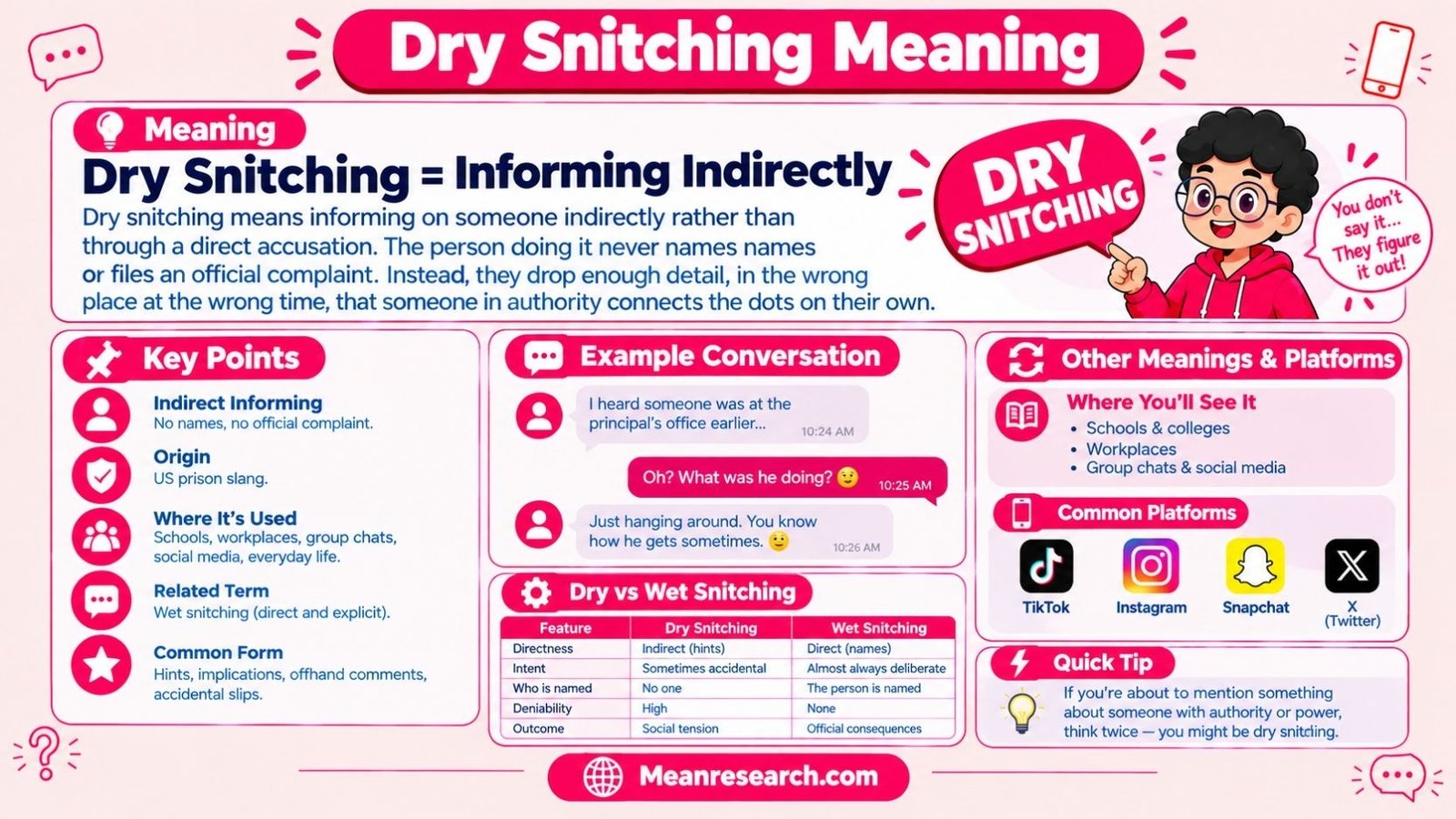
Dry snitching means informing on someone indirectly rather than through a direct accusation. The person doing it never names names or files an official complaint. Instead, they drop enough detail, in the wrong place at the wrong time, that someone in authority connects the dots on their own.
This guide breaks down the full meaning, origin, and real-world use of dry snitching so you can spot it, avoid it, and understand it wherever it shows up.
What Does Dry Snitching Mean?
At its core, dry snitching is the act of informing on someone through implication instead of a clear statement. Dictionary.com defines it as the process of informing on another person indirectly or through implication rather than through a direct statement or accusation. That distinction matters because it separates dry snitching from the kind of snitching most people picture, where someone walks up to an authority figure and names a name.
Green’s Dictionary of Slang, a respected academic reference for informal and regional English, frames it slightly differently. It describes dry snitching as an act of informing committed by innuendo, or even by accident, rather than by direct accusation, and notes it can also refer to the person who habitually informs this way.
That second part is worth sitting with. Dry snitching is not always a deliberate strategy. Sometimes it is a slip, a careless comment, or an offhand remark that gives someone away without the speaker meaning to expose anyone at all.
Wiktionary keeps the definition simple and functional. It defines the verb form, to dry snitch, as informing on somebody indirectly or by implication. Strip away the slang and street context, and that is really the whole idea. You are not the one who technically told. You just made sure the truth got where it needed to go.
Read More: Emotionally Mature Meaning
Dry Snitching Meaning Slang: Where the Term Comes From
Dry snitching did not start on social media, even though that is where most people encounter it today. Green’s Dictionary of Slang traces the term to US prison slang, where it originally described informing by innuendo or even by error rather than through a direct accusation. Prisons developed an entire vocabulary around information control, because in that environment, being seen as an informer carries real physical risk.
A related definition sharpens the picture further. Inside prison walls, dry snitching also referred to talking in a loud enough voice, or otherwise drawing a guard’s attention, so that officers picked up on wrongdoing without the speaker ever naming a name. The goal was plausible deniability. You never told. You just made sure the person in charge heard enough to act.
That NetLingo entry adds an important detail about how the term migrated. It notes the workplace version works the same way: a coworker speaks loudly enough near a supervisor to get someone in trouble, all while technically never reporting anything themselves. This is the same mechanic prison slang described, just relocated to a cubicle instead of a cell block.
From there, the phrase spread into general slang, especially online. One deeper explainer traces its cultural roots even further. It connects dry snitching to urban slang traditions within Black American communities, where indirect exposure became its own recognized category because directly informing authorities could carry serious, sometimes life threatening, consequences. That context helps explain why the word “dry” carries so much weight here. It signals something done quietly, without the mess or the risk of a direct accusation.
Quick Fact Box
- Origin: US prison slang
- First documented sense: informing by hint or implication rather than direct statement
- Modern use: schools, workplaces, group chats, social media, group texts
- Related term: wet snitching, the direct opposite
Dry Snitching Vs Wet Snitching: What Is the Difference?
Once dry snitching entered everyday slang, people needed a word for its opposite, and that is where wet snitching comes in. Wet snitching is a direct, intentional, and explicit act of reporting someone’s wrongdoing to an authority figure or to someone who can impose consequences. There is no hint dropping and no plausible deniability involved. A wet snitch walks straight up and names the person.
The clearest distinctions between the two come down to intent, directness, and consequences: dry snitching can be accidental while wet snitching is almost always deliberate, dry snitching relies on hints and implication while wet snitching is explicit and leaves no doubt, and dry snitching tends to produce social tension while wet snitching tends to trigger direct, official consequences because a clear report was actually filed. Understanding both terms side by side makes the meaning of each one click faster.
| Feature | Dry Snitching | Wet Snitching |
| Directness | Indirect, through hints or implication | Direct and explicit |
| Intent | Sometimes accidental | Almost always intentional |
| Who is named | No one is named outright | The person is named clearly |
| Deniability | High, the speaker can claim innocence | None, the report is on record |
| Typical outcome | Social tension, suspicion, subtle fallout | Formal consequences, official action |
| Common setting | Group chats, casual conversation, gossip | HR complaints, police reports, direct confrontation |
Dry Snitching Example: How It Plays Out in Real Life
Seeing dry snitching in action makes the definition much easier to remember than reading it in the abstract. Real examples show up in classrooms, offices, group chats, and even between siblings. Below are a few patterns pulled from how people actually describe the behavior.
Example 1: The Unintentional Slip. A sibling sneaks out to a party they were told to skip. The next morning, a parent asks how the night went, and without thinking, they answer honestly in front of everyone. This kind of accidental exposure is a textbook case of unintentional dry snitching, where the person never meant to give anyone away but did anyway.
Example 2: The Deliberate Hint. Someone notices a friend broke a shared rule and wants that friend to face consequences, but does not want to be seen as the one who told. They might casually mention seeing that person near the scene right before something went missing, offering just enough detail for the authority figure to draw their own conclusion without ever making a direct accusation. No name was said out loud, yet the damage is already done.
Example 3: The Workplace Version. A coworker speaks loudly enough near a manager’s office to make sure the manager overhears something they were never technically told, getting a colleague in trouble without ever filing an official report. This example shows dry snitching does not require malice or even a spoken accusation, just a well placed comment at the right volume.
Example 4: The Online Version. A vague social media post references a situation everyone in a friend group can identify without a name attached. Readers fill in the blank on their own, and the person who posted it can always claim they were not talking about anyone in particular. This is the format that made dry snitching a familiar term to younger audiences who grew up online.
Read More: Smirking Face Meaning
Dry Snitching on Yourself: What That Phrase Means
The phrase dry snitching on yourself flips the usual setup. Instead of exposing someone else, you accidentally reveal your own wrongdoing through an offhand comment, a slip in a story, or an inconsistency someone else catches. You never meant to confess anything, yet the details you shared did the confessing for you.
This usually happens in low stakes, casual moments. Someone recounts a story to a friend and includes a detail that only makes sense if they broke a rule or did something they were not supposed to do. The listener puts the pieces together instantly, even though the speaker never intended to admit anything. That is dry snitching turned inward, and it is one of the more common ways the phrase gets used in everyday conversation today.
Dry Snitching Meaning: What Urban Dictionary And Slang Communities Say
Crowd sourced slang dictionaries capture how real people use dry snitching day to day, which is different from a formal definition. One popular entry describes dry snitching as intentionally getting someone in trouble by exposing something they did wrong while trying to stay sly about it, distinguishing between the intentional version and the purely accidental version where a person reveals something without meaning to.
Another widely cited entry frames the behavior around technique rather than intent. It describes dry snitching as a method of indirectly informing authority figures about someone else’s wrongdoing while avoiding any appearance of being connected to the offense or gaining anything from reporting it. That framing highlights the self protective motive behind a lot of dry snitching. The person wants the outcome of snitching without the social cost that comes with being labeled a snitch.
A separate slang source adds a useful nuance about how deliberate dry snitching actually works in practice. It explains that when the telling is purposeful, small identifying details are usually left out on purpose, so the disclosure never quite crosses the line into direct informing even though the outcome is exactly the same. This is the mechanic that makes dry snitching frustrating for the person on the receiving end. There is no clear moment to point to and say, you told on me, because technically, no one did.
Dry Snitching Meme Culture and Why It Went Viral
Dry snitching exploded online because it describes a very specific, very relatable social dynamic that almost everyone has witnessed or done themselves. Group chats, comment sections, and story replies are full of moments where someone says just enough to expose a friend without tagging them. The behavior lends itself perfectly to memes, since the humor comes from everyone in the audience instantly recognizing the pattern.
The phrase also caught on because it gives people language for a feeling that used to be hard to describe. Before the term spread, there was no quick way to call out someone who technically never told on you but somehow got you caught anyway. Once the phrase existed, people started applying it everywhere, from sibling arguments to office politics to relationship drama playing out in comment sections.
How to Tell If You Are Dry Snitching
Most people who dry snitch do not think of themselves as snitches at all, which is exactly why this checklist helps. Ask yourself these questions the next time you are about to mention something involving someone else.
- Are you giving information to someone with authority or power over the other person, rather than just venting to a friend?
- Are you leaving out the person’s name on purpose, even though the details make it obvious who you mean?
- Would you feel exposed or defensive if someone called this out as snitching?
- Are you framing the information as a concern, a question, or an observation instead of a direct statement?
- Would the other person have wanted this information kept private?
Note Box: If you answered yes to most of these, the behavior likely counts as dry snitching, even if you never intended harm. Intent does not change the outcome for the person who gets exposed.
Why People Dry Snitch
People rarely set out labeling their own behavior as dry snitching, yet the pattern shows up constantly once you know what to look for. A few motivations come up again and again in how people describe this behavior online and in everyday conversation.
- Avoiding the snitch label. Direct informing carries social stigma in many groups, so indirect exposure feels safer to the person doing it.
- Wanting a result without the blame. The goal is getting someone in trouble while staying protected from any backlash that follows.
- Genuine carelessness. Not every case is calculated. Plenty of dry snitching happens because someone simply was not thinking before they spoke.
- Frustration or resentment. Sometimes dry snitching is a passive way to express anger at someone without confronting them directly.
How to Respond If Someone Dry Snitches on You
Getting exposed indirectly can feel more frustrating than a direct accusation, mostly because there is no clean way to confront it. A few practical approaches can help you handle the situation without escalating it further.
- Address it privately first. Talk to the person one on one instead of calling them out publicly, since dry snitching thrives on ambiguity that a direct conversation removes.
- Focus on the pattern, not just the moment. If this keeps happening, name the behavior clearly so the person understands the impact of what they are doing.
- Avoid retaliating with wet snitching. Responding to indirect exposure with a direct report of your own usually escalates tension rather than resolving it.
- Accept that some exposure is accidental. Not every instance is malicious, so it helps to judge the pattern over time rather than reacting to a single slip.
Warning Box: Confronting a dry snitch in a group setting often backfires, since they can simply deny any intent to expose you. A private, calm conversation almost always works better than a public callout.
Read More: Deenie Meaning
Snitching Meaning In Urdu
For readers searching in Urdu or bilingual communities, snitching translates roughly to مخبر بننا (mukhbir bannaa), where مخبر (mukhbir) means an informer or one who passes on information to authorities. The closer everyday equivalent for casual tattling or gossiping is چغلی کرنا (chugli karna), which describes telling on someone or spreading word of their behavior, often in a petty or disapproving sense.
Dry snitching does not have one fixed Urdu equivalent, since it is a very specific piece of English internet slang, but the closest way to express the idea is اشاروں میں چغلی کرنا (isharon mein chugli karna), meaning to tattle through hints rather than saying it outright. This captures the same indirect, implication based meaning that defines dry snitching in English.
Frequently Asked Questions
What does dry snitching mean in slang?
Dry snitching means informing on someone indirectly, through hints or implication, rather than through a direct, named accusation.
What is the difference between dry snitching and wet snitching?
Dry snitching is indirect and sometimes accidental, while wet snitching is a direct, intentional, and explicit report naming the person involved.
Where did the phrase dry snitching come from?
The term originated in US prison slang, describing informing through innuendo rather than an outright statement to guards or authorities.
Can dry snitching be accidental?
Yes, many cases happen when someone shares a detail without realizing it exposes another person’s wrongdoing.
What does dry snitching on yourself mean?
It means accidentally revealing your own wrongdoing through a careless comment or inconsistency in a story you told.
Is dry snitching considered worse than regular snitching?
Opinions vary, but many people find it more frustrating since the person avoids blame while still causing the same consequences.
How do you know if you are being dry snitched on?
If someone gives an authority figure just enough detail to identify you, without ever saying your name, that counts as dry snitching.
Is dry snitching only used in prison slang anymore?
No, it has spread into schools, workplaces, group chats, and social media, far beyond its original prison context.
What is a wet snitch?
A wet snitch is someone who directly and openly reports another person’s wrongdoing without hiding their involvement.
How should I respond if someone dry snitches on me?
Address it privately, focus on the pattern rather than one incident, and avoid retaliating with a direct report of your own.
Final Takeaway
Dry snitching meaning comes down to one core idea: getting someone in trouble without ever technically telling on them. Whether it started in a prison cell, spread through a workplace, or shows up in a group chat today, the mechanics stay the same. Someone drops just enough information for the truth to surface, while staying just far enough removed to deny any responsibility.
Knowing the difference between dry snitching and its more direct counterpart, wet snitching, gives you the language to spot this behavior wherever it shows up, and the tools to handle it without letting it damage your relationships.

Hooriya Salman is the writer and researcher behind Mean Research, with 4 years of experience researching and writing about word meanings, slang, names, and everyday language. Their aim is to provide clear, accurate, and easy-to-understand explanations that help readers discover the meaning behind unfamiliar words, expressions and names.